Automatic LLM Fallback Routing When a Primary Provider Goes Down
Keep your LLM service running even when your primary provider fails without manual intervention.
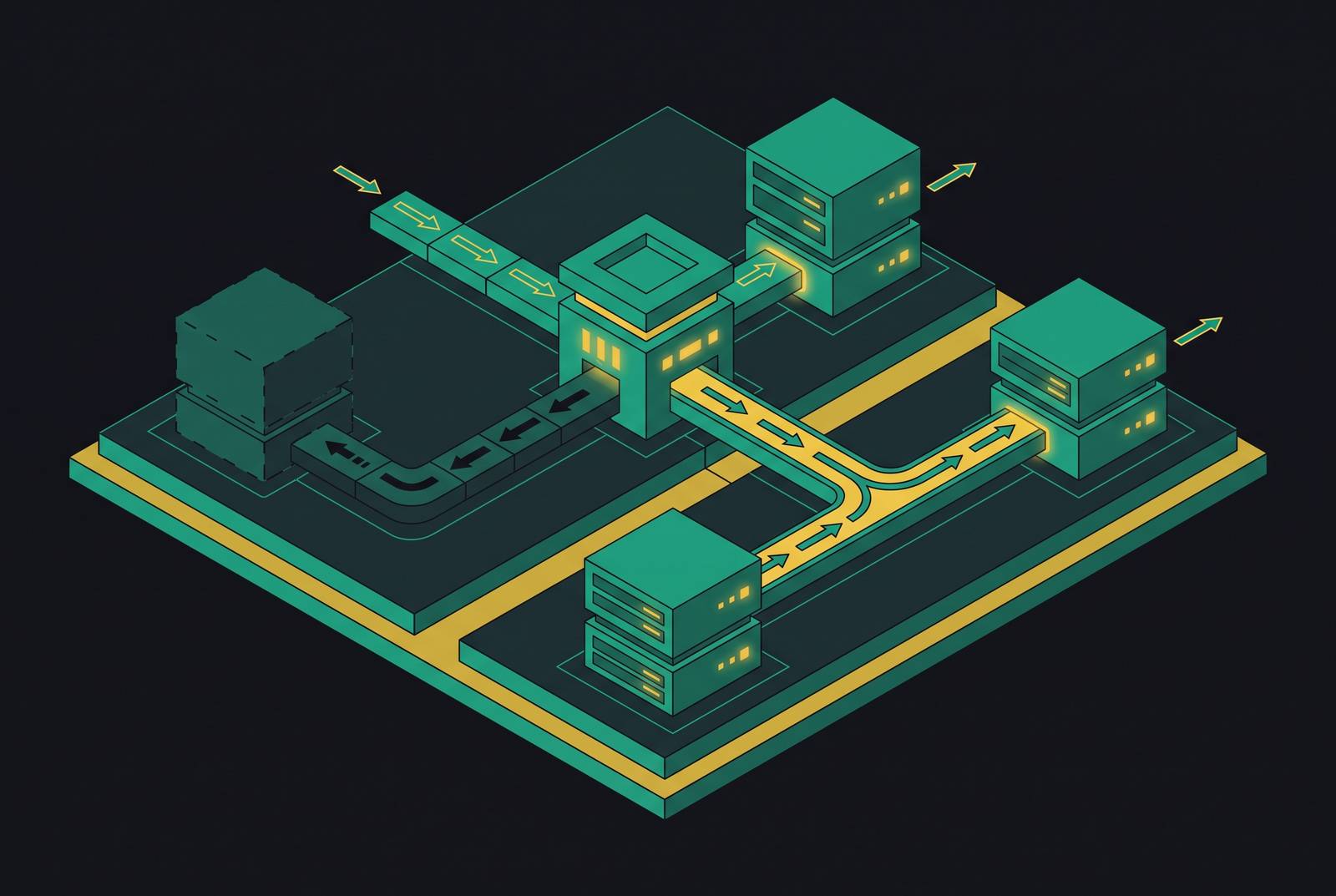
Automatic fallback routing is the mechanism that keeps a production AI system running when the LLM provider it depends on goes down. Most teams assume their provider is basically always up, and that assumption fails often enough that building around it becomes the real job. I've watched this play out at three different companies now, and the pattern repeats: nobody thinks about fallback until the week after it would have saved them.
OpenAI, Anthropic, and Google all report incidents most months, whether that's a full outage, partial degradation, or an error rate that spikes with no warning attached. The SLA numbers look clean on paper. A high-nines uptime figure sounds like nothing to worry about, until you convert it into hours and realize the math guarantees meaningful downtime every single month. That's the floor.
Latency spikes count too, and so does rate-limit enforcement, which from your application's point of view looks exactly like the provider dropped off the map. Here's what catches teams off guard: running two providers isn't automatically safe, because plenty of LLM vendors sit on the same underlying cloud infrastructure. One region goes down and your "redundant" setup goes down right along with it.
What happens during an outage is simple and ugly. Requests fail, users see errors, and workflows that depend on a response either queue up or drop entirely. The real cost compounds beyond the outage itself, in the cascade that follows. A support copilot goes dark for an hour. A data pipeline stalls mid-run. An agent sits waiting on a call that's never coming back. One B2B SaaS team was hit by three separate outages across three separate providers and handled each one by hand: same root cause, three different runbooks, no automated fallback layer sitting between them. Handling it that way depends on luck holding, one incident at a time.
What automatic fallback routing actually means, and what it does not
Here's the definition, stripped down: the system detects a failed or degraded LLM request and retries it against a different provider or model, with no human touching anything and no application code changing. That's it. Everything past that is implementation detail.
Two words get used interchangeably that shouldn't be: failover and fallback. Failover responds to infrastructure failure, things like server errors and network timeouts. Fallback responds to semantic failure, which is a different animal: a rate limit gets hit, a context window overflows, a guardrail blocks the output, or the response comes back but doesn't clear a quality bar you set. Most teams build failover first, because it's the obvious problem sitting right in front of them. Fallback gets bolted on later, usually after the second category bites someone hard enough to get budget approved.
Retry and fallback get confused too, and mixing them up burns money in both directions. A retry hits the same provider and the same model after a short wait, which is fine for a transient blip. A fallback switches to a different provider or model entirely, and that only makes sense when retrying the same broken endpoint is just going to fail again. Retry too aggressively against a downed provider and you waste time. Fall back too eagerly and you're paying for capacity you never needed.
"Automatic" means the routing decision happens at the infrastructure layer, before your application ever sees a failure, inside the latency window your user actually experiences. And it can't be silent. Unexplained model-swapping with no record of what happened defeats the purpose almost entirely; teams need to know, after the fact, which provider served which request and why, or they've just traded one blind spot for another.
The five failure modes that a fallback strategy must handle
Not every failure looks the same. A system built to catch one type will quietly miss the rest, and it won't tell you it's missing them.
Infrastructure failure is the easy one. The provider returns server errors or goes unreachable outright. Simple to detect, simple to build for.
Timeout is meaner. The provider accepts the request and just never answers inside a window you can live with. Catching this needs an actual configured ceiling, not a scan for error codes, because a stalled request that never technically errors out looks, mechanically, like nothing happened.
Rate limiting is its own thing again. The connection goes through fine, but the request gets rejected on quota grounds. To the user sitting there waiting, the effect is identical to a full outage even though the provider is, technically, healthy the entire time.
Context-window overflow means the request is too big for the model you sent it to. The fallback here has to be a model with more room, specifically, or you've routed to a failure that looks slightly different but breaks the same way.
Then there's the quality-floor miss, and this one's the sneaky one. The response comes back, it's formatted fine, nothing threw an error, but it fails whatever check your downstream system uses to decide "good enough." That check has to be defined ahead of time and instrumented at the gateway. Otherwise this failure mode never gets caught, ever.
Five failure modes, five different detection signals: HTTP status, elapsed time, specific error text, and actual content evaluation sitting on top of all of it. Build one catch-all rule for all five and you'll cover maybe one of them properly.
Where fallback routing lives in the stack and why that placement matters
The instinct most engineers reach for first is application code. Try the primary, catch the exception, call the secondary. Works fine, at first, for one service.
Then a second service needs the same thing, and a third, and now every team is writing slightly different versions of the same logic that don't talk to each other. There's no unified view across providers, so incidents get discovered service by service, sometimes hours apart, sometimes never correlated at all. Want to rotate credentials, swap an endpoint, add a third provider? Code change, redeploy, every single time.
An alternative approach places this logic in a gateway: a reverse proxy sitting between all your application code and every LLM provider you touch, presenting one stable interface to everything behind it. Authentication, routing rules, fallback logic, rate-limit tracking, cost accounting, audit logging: it all lives in one place instead of being scattered across a dozen codebases nobody fully remembers writing.
The value is decoupling, plain and simple. When your application talks to one interface, swapping a model or wiring in a new fallback path becomes a config change instead of a refactor. It's the same reason nobody stuffs load-balancing logic inside application code anymore. That decision doesn't belong there, no matter how trustworthy any single web server happens to be. And the overhead argument doesn't really hold up either; even sophisticated routing logic adds a sliver of the latency that inference itself already costs on top.
How fallback routing logic is structured in practice
At the core, fallback routing needs an ordered list of providers, a set of trigger conditions, and a routing action tied to each one. Everything past that is variation.
A handful of patterns have settled into something like standard practice. Provider rotation keeps a priority-ordered list and moves down it as things fail. Model downgrade routes to something smaller and cheaper, same provider or a different one, when staying available matters more than raw capability in that moment. Retry-then-fallback tries the primary a set number of times before escalating, so you're not switching providers over a blip that would've resolved on its own in two seconds. Cache-on-failure serves up a stored prior response when nothing live answers, which is fine for read-heavy workloads and a bad idea anywhere freshness actually matters. Manual-route override lets a human pin a specific provider during a known incident, overriding whatever the automated logic would otherwise do.
A well-built system layers these patterns together rather than picking just one. Retry twice, fall back to the secondary, downgrade the model tier if the secondary starts struggling too. Retry-then-fallback covers the transient stuff, provider rotation covers sustained outages, model downgrade covers cost and latency pressure, and cache-on-failure covers the narrow slice of cases where stale data is genuinely fine.
One thing sits underneath all of it, and it trips people up constantly: if two of your providers happen to run on the same cloud region, a regional outage takes both down together. A fallback strategy that actually holds needs a third option with real infrastructure independence, not just a different logo on the invoice.
What gets configured to make fallback actually work under real outage conditions
Timeout thresholds come first, and they can't be one global number. A streaming chat interface and an overnight batch job tolerate waiting completely differently, so the ceiling needs to be set per use case, not copy-pasted across all of them.
Error-code mapping matters just as much. A blanket "retry on any error" rule behaves fine against a server error and terribly against a rate limit, where retrying immediately just digs the hole deeper. Retry count and backoff need the same attention: hammer a provider that's already rate-limiting you without exponential backoff and you're making the situation worse, not better.
The circuit breaker pattern earns its keep here. After a set number of consecutive failures, stop sending requests to the primary for a cooldown window, instead of letting every single request fail one at a time and pile onto a provider that's already on its knees. Health checks add a layer on top of that: proactively pinging provider endpoints so the gateway can route around a known-bad provider before the first real user request ever touches it.
Fallback priority ordering, meaning which provider is secondary and which is tertiary, needs to weigh more than uptime history alone. Cost sensitivity, data residency rules, capability tier: all of it factors in.
And here's the quiet failure mode that gets almost everyone eventually. Fallback rules get configured once, at setup, and never revisited. Provider lineups shift. Models get deprecated. New use cases get bolted on without anyone touching the fallback config written for a completely different set of assumptions. None of that throws an error. It just sits there quietly, going stale, until the day it's needed and doesn't work.
The model compatibility problem that fallback routing cannot solve on its own
Most fallback configs carry a hidden assumption: that the secondary model will produce something close enough to what the primary would've said. That assumption breaks more often than anyone expects going in.
Context windows differ across models, so a prompt that fits fine on the primary can overflow on the fallback. Output format, verbosity, instruction-following, all of it varies too, and downstream parsing built around the primary's habits can fail even when the fallback call technically succeeds. Tool use, function calling, structured output schemas: these vary model to model, and a fallback that doesn't support the same capabilities ends up behaving like a different product wearing the same name tag.
Prompt engineering makes this worse. Prompts get tuned, sometimes over months, to a specific model's quirks, and none of that tuning transfers. The fallback model answers the exact same prompt and hands back something noticeably worse, and nothing in the pipeline ever throws an error to tell you.
Most teams test their primary provider hard and never run the same test suite against the fallback. So the first time anyone notices the fallback behaves differently is during the outage it was built for, which is precisely the worst moment to learn that. Fallback routing keeps requests alive, but staying alive and staying correct are two separate outcomes, and no routing logic on earth closes that gap; the quality check still has to happen up at the application layer.
Cost and quality tradeoffs when the fallback model is not the same tier as the primary
The price gap between model tiers has widened enough that routing choices now carry real budget consequences. A frontier model and a lightweight model from the same provider family can differ by orders of magnitude in per-token cost, and that spread only becomes visible once something forces the routing decision, like an outage does.
Research on intelligent routing presented at ICLR in recent years found that sending a meaningful share of queries to smaller models cuts cost substantially while holding onto most of the quality, at least on tasks that don't need frontier-level reasoning to begin with. The insight underneath that is simple enough: not every request needs the same model. A classification task and a multi-step reasoning chain shouldn't share a fallback tier, even when both currently route through the same primary provider.
Task-aware fallback means configuring different fallback targets for different workflows instead of writing one rule to cover everything the system does. Downgrading works fine for internal summarization, classification, extraction, and anywhere the output doesn't face a customer directly, where a slightly rougher answer is recoverable.
It does not work for customer-facing generation, where output quality is part of the product itself. It doesn't work when a downstream system expects a specific structured output and a weaker model can't reliably hit it. And it absolutely doesn't work in clinical, financial, or legal contexts, where a weaker model doesn't fail loudly; it produces something plausible-sounding and wrong, which is worse than an error message. Cost optimization and reliability fallback are related configurations chasing different goals, and treating them as one rule produces bad outcomes on both sides of that line.
Observability requirements for a fallback system that can be trusted in production
A fallback that fires silently carries risk of its own, safeguard or not. That's worth sitting with for a second: the thing built to protect you can become the thing you can't see.
At minimum, logs need to capture which provider and model actually served each request, whether the request went through the primary or a fallback, what condition triggered the switch, and end-to-end latency including whatever the switch itself added. This has to happen per request, not just in aggregate, because reconstructing an incident means knowing exactly which requests were affected, in what order, and what each one got served back. Aggregate dashboards flag that something broke, but reconstructing what actually happened underneath requires the per-request detail.
Fallback activity should be a monitored signal on its own, not a background event nobody checks. A sudden spike in fallback triggers is often the earliest sign a provider is degrading, well before it shows up anywhere else in your metrics. Teams running multiple providers without a shared view end up stitching together logs from separate dashboards after the fact during incident review, which is its own tax stacked on top of the outage.
Cost tracking belongs in these same logs. A temporary fallback to a pricier provider still hits the budget, and if the logs don't capture which model handled which request, cost attribution just falls apart on you. In regulated industries this stops being optional entirely: knowing exactly where data got routed is part of the compliance record, not something bolted on after the fact because someone asked.
How to evaluate and test a fallback setup before it is needed in production
Almost every team makes the same mistake: fallback gets configured once and then assumed to work, forever, with nobody checking back in. Actual testing under simulated failure conditions is rare enough that it's basically the exception rather than the rule.
Testing needs to confirm the fallback fires correctly on every trigger condition on its own: timeout, server error, rate limit, context overflow. A generic stand-in labeled "failure" tests one scenario and leaves the rest to assumption. A system that catches server errors but ignores timeouts has been tested against exactly one scenario, with the rest simply assumed to generalize, which they usually don't.
It also needs to confirm the fallback model produces genuinely usable output for the task at hand, not just that a response comes back at all. And this has to happen before an outage forces the question, because that's the single worst moment to discover the fallback doesn't actually work. Building the routing layer is half the job; proving it holds under conditions you haven't seen yet is the other half, and it's the half most teams skip, right up until the week they can't afford to anymore.