LLM Gateway Architecture for Production AI Teams
How production teams manage explosive LLM spending through intelligent routing and unified gateways.
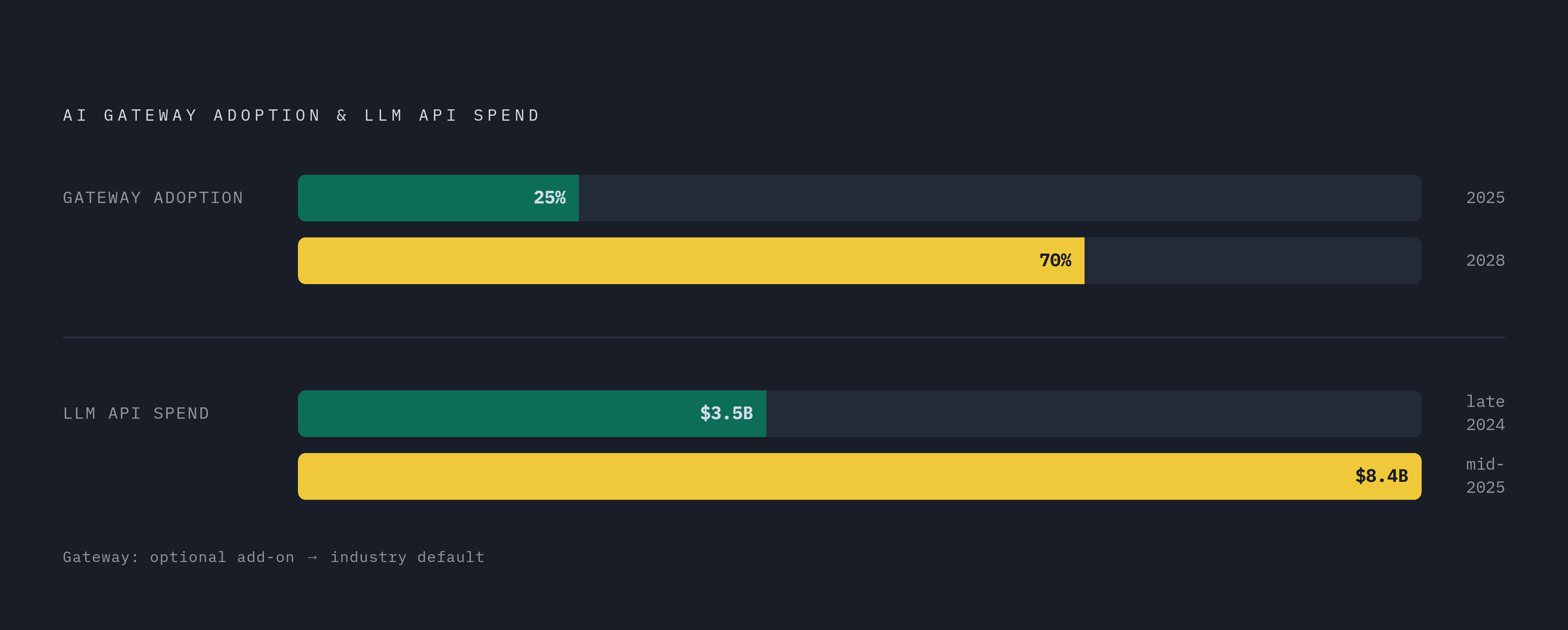
Enterprise spending on LLM APIs more than doubled in about six months, jumping from $3.5 billion in late 2024 to $8.4 billion by mid-2025. That kind of growth breaks the way most teams talk to model providers today. The LLM gateway has quietly turned into the piece of infrastructure every serious AI team ends up building or buying, whether they planned for it or not.
Adoption isn't some future state anymore. Something like 92% of Fortune 500 companies already use generative AI somewhere in their workflows, and most of them started the same way: one provider key per team, a few SDK calls sprinkled through the app, a separate dashboard for every provider they happen to touch. Fine for one provider and one team, but it falls apart the moment you add a second.
And it breaks in a specific way. Every new provider means new keys, new rotation policies, new secrets sitting somewhere they probably shouldn't. OpenAI's request format looks nothing like Anthropic's, and cloud wrappers stack another shape on top of that, so your app code fills up with custom handling just to keep the lights on. Spend data, latency data, error data: all of it sits in separate silos, one per provider, so nobody has a single view of what your AI systems cost or how they're behaving. If one provider has a bad afternoon, every workflow leaning on it goes down with it.
A team running two providers and three models can hold this together by hand. A team running six providers and a dozen models can't, not without rethinking the whole setup. One industry projection puts a number on it: roughly 70% of software teams building multimodel applications will use AI gateways by 2028, up from around 25% in 2025. Direct integration was a reasonable starting point in the early days, the same way hand-rolled auth worked fine until every serious app started using an identity provider instead.
What an LLM gateway actually is and where it sits in the stack
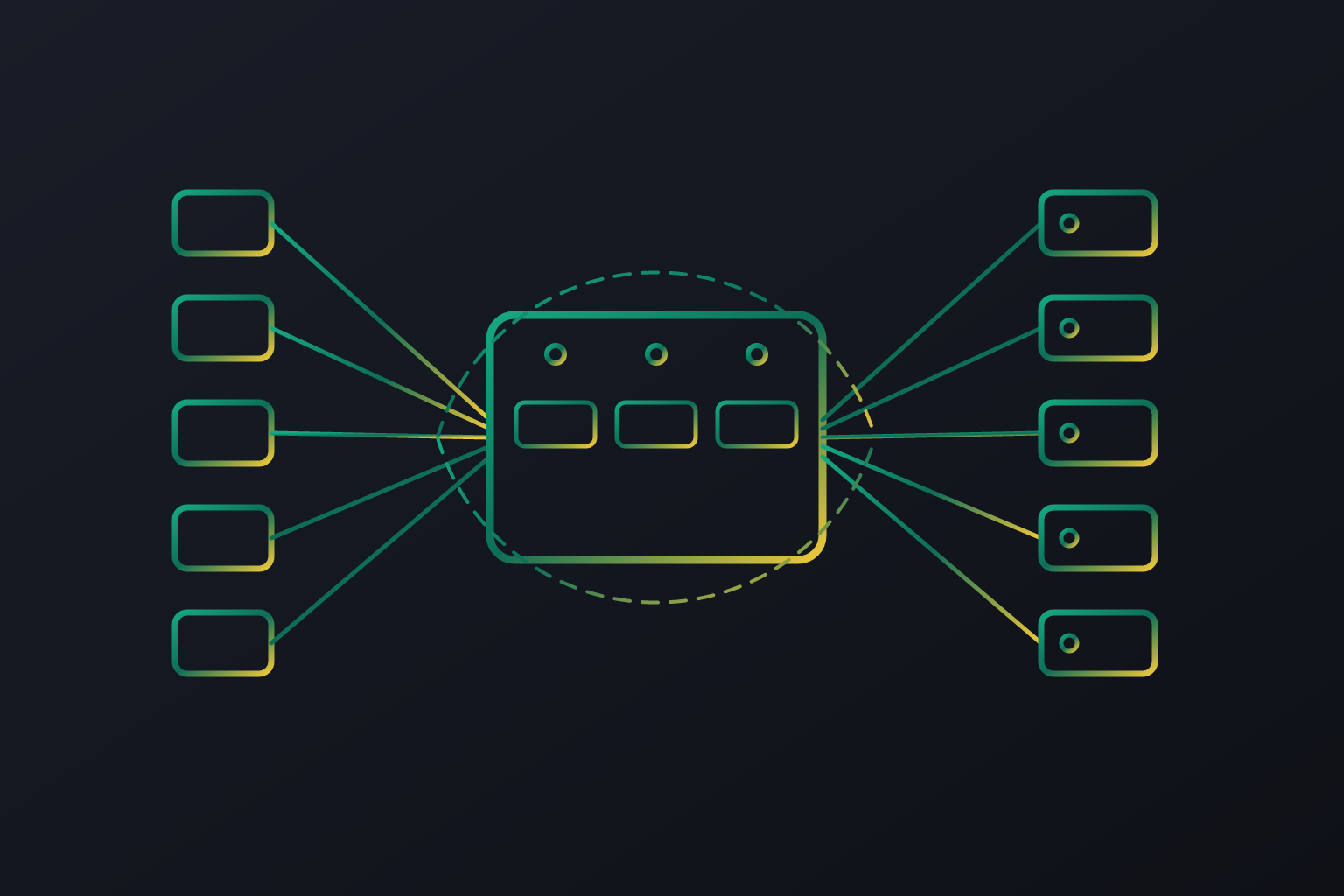
An LLM gateway is a reverse proxy sitting between your application and every model provider you use. It catches each request before it leaves your system, applies whatever routing logic you've set, then sends it where it needs to go.
From the app's point of view, there's one endpoint, one way to authenticate, one request format, no matter which model ends up doing the work underneath. All the messy provider-specific stuff gets pushed down into the gateway, where nobody has to think about it twice.
That layer carries a lot of weight on its own. It manages credentials for every provider you've got, routes and load-balances requests across models, enforces rate limits and spend caps and content filters, redacts PII, logs every request tagged by team and project and model, and handles fallback the moment a provider slows down or drops a connection.
It's the same idea that made API gateways standard for REST services years back, pointed now at model providers instead, with a couple extra wrinkles around token economics and the fact that outputs aren't deterministic the way a REST response usually is.
One distinction gets underrated: a gateway sits outside your application code entirely, so policy applies the same way to every team and every request without anyone touching a codebase. Teams that bolt monitoring onto the app layer after the fact usually end up with traces scattered across five tools that don't talk to each other, chasing a bug through logs that contradict one another. A gateway already sees everything going out the door.
How intelligent routing across providers works and what it actually saves
Every LLM call trades off cost, latency, and quality, and push on any two and the third gives.
That tradeoff carries real money behind it. The gap between frontier models and budget models already reaches 100x in 2026, so which model handles a given request stops being a small decision once you're at any real volume. It's the difference between a bill you can explain to your CFO and one you can't.
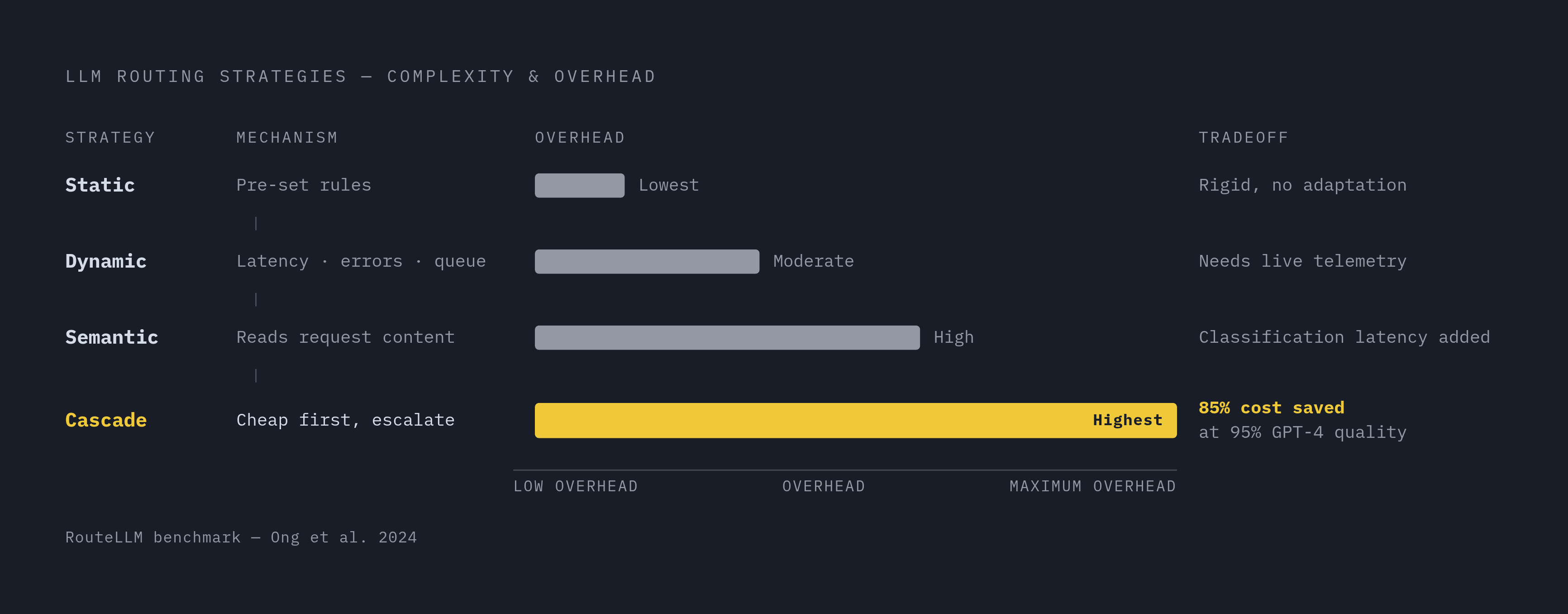
A handful of routing strategies show up in practice. Static routing uses pre-set rules per request type: cheap to run, fine for workloads that don't shift much. Dynamic routing watches real-time signals, latency, error rate, queue depth, and picks a provider on the fly, which suits high-volume or latency-sensitive traffic. Semantic routing reads what the request is actually asking before sending it anywhere, so a simple FAQ question goes to a small model and a hard reasoning task goes to a frontier one. Cascade routing sends the request to a cheap model first, checks if the output clears a quality bar, and only escalates if it doesn't; most accurate approach, but also the one with the most overhead per request.
The RouteLLM research backs this up: their router hit 85% cost savings while holding onto 95% of GPT-4's quality on MT Bench and MMLU benchmarks. Separately, ICLR 2025 work on matrix-factorization routing found that only 14% of queries needed to go to the strong model to achieve competitive results. Your results will depend on your workload mix and which models you pair up, but the technique holds. Separately, Amazon's published SageMaker benchmarks found switching to least-outstanding-requests routing improved P99 latency by 4 to 33% over random routing at production scale. Routing touches your tail latency too, and that matters more than most teams admit until they've been paged for it.
There's a quieter risk I don't see watched closely enough. If a provider updates a model and it breaks your cheap model's output format, your router might start escalating everything to the expensive model, and you eat the cost of both calls, every single request, with nothing flagging it until the invoice lands. Escalation rate deserves its own SLO.
Hardcoding one model and calling it a day works fine for a prototype, but it doesn't hold up in production. No single model wins across every task, every volume, every latency budget, and every price point at once. Routing is how production teams match the work to the right model, instead of defaulting to whatever key happens to sit in the config file.
Spend visibility and budget control as infrastructure requirements, not reporting afterthoughts
According to SpendHound's 2026 AI Spend Report, 46% of finance and procurement leaders blew past their AI budget in 2025. Compare that to finance and accounting software, where the overrun rate sat at 37%. AI spend runs hotter, and less predictably, than the software categories finance teams already know how to manage.
Part of the reason: SaaS spend is seat-based, so it's boring and predictable, almost by design. Token spend moves with workload, and it can spike without a single human ever deciding to spend more. One team adopting an agent workflow can reshape the whole month's bill on its own, without anyone signing off.
Agents make this worse. One agent stuck in a retry loop, or one that spawns sub-agents with no cap on how many, can burn through token volumes no developer would ever produce typing requests by hand. Agentic AI doesn't just push average spend up; it introduces the kind of swing that makes budgeting genuinely hard to plan around.
Getting a grip on this takes attribution at every layer: every API call traceable to a specific agent or user, every agent traceable to an owner and team, every owner sitting inside a defined budget. Industry practice points to exactly this: strict consumption limits, budgets segmented by department or application, hard financial boundaries instead of soft guidance nobody follows under pressure. The pattern that works is three layers: a global ceiling, team-level allocations under that, individual or per-key caps under those, with limits enforced the moment a request is made, not discovered later on an invoice.
A gateway does this in a way application-layer instrumentation just can't match. Every request passes through one control point, so spend attribution, cap enforcement, and alerting happen the same way, everywhere, automatically. Teams instrumenting at the app layer instead tend to find gaps opening up every time a new model or provider or agent gets added, because somebody always forgets to update the tracking code.
The real goal underneath all of it is unit economics: cost per customer, per feature, per transaction. That's what tells you whether your AI usage runs efficiently, and a big spend number by itself doesn't say much about whether that money's well spent.
Security and compliance controls the gateway enforces before requests reach a provider
Here's the exposure most teams don't think hard enough about: application code talking to provider APIs directly has no systematic way to inspect or redact what's inside a request before it leaves the building. PII, PHI, PCI data, internal credentials, all of it can travel to an external model endpoint based purely on whatever the app happens to pass along, with nothing checking in between.
A regulated deployment needs a specific set of controls built in architecturally from the start. Deployment isolation, in-VPC, on-premises, or air-gapped setups, so request data never crosses a shared public layer. Runtime PII and PHI redaction, where sensitive data gets flagged and stripped or masked before a request reaches a provider, and that process has to be auditable, not just assumed to work because someone wrote a regex once. Tamper-evident audit logging, every request and response recorded with immutable timestamps, user identity, model, and provider attached, which HIPAA, SOC 2, and most financial services frameworks require outright. And identity-aware access control, RBAC tied into whatever identity provider you already run, so which models a team can call and how much they can spend gets governed by role, not by whoever happens to be holding a key that day.
Zero data retention agreements exist from several major providers, but somebody has to opt in and verify them, provider by provider, one at a time. A gateway is where that configuration gets enforced consistently, instead of relying on someone remembering it as a checkbox for every single integration.
The RBAC piece deserves its own line. Access control at the gateway means a newly onboarded team can't call a production model, blow past a spend cap, or reach a sensitive endpoint without someone explicitly granting that permission first, no code change required. Policy lives in one place and gets managed centrally, and that's a very different picture from chasing down permissions across a dozen codebases.
None of this is an enterprise-only concern. Any team, at any size, handling customer data in an AI workflow carries the same data protection obligations a large enterprise does. The gateway pattern is what makes those controls achievable without every team needing to build custom security engineering around every provider they touch. The real question for an engineering leader is whether to build these controls once, at the gateway, or over and over, in every application that happens to call a model.
Reliability engineering in the gateway layer (fallbacks, failover, and uptime at provider scale)
A lot on the provider side sits outside your control: rate limits, outages, model deprecations, latency spikes during peak demand, silent changes to output whenever a provider pushes a model update without much warning.
Without a gateway, a provider outage takes down every workflow hardcoded to that provider, and there's no fallback path unless someone specifically wrote the app code to handle it, which most app code doesn't.
A gateway gives you a fallback hierarchy instead: primary provider, then secondary, then a cached response or some form of graceful degradation if both fail. The application layer just sees a response come back, like nothing happened, and provider failures get absorbed at the gateway, sparing whoever's on call from chasing the fallout directly.
Rate limits work the same way. A gateway spreading traffic across multiple provider keys, or multiple providers entirely, can absorb spikes that would otherwise slam into a single key's ceiling. That's horizontal scaling handled at the infrastructure layer, sparing engineers from rebuilding it into every application separately.
A well-built gateway doesn't cost much in latency either, which surprises people the first time they see the numbers. Independent engineering benchmarks on gateways built in fast, compiled languages show overhead in single-digit to low double-digit microseconds per request, even at thousands of requests per second. The reliability and routing gains don't come at a real latency cost, so long as the gateway itself is built well.
Model deprecation is its own headache, and an ongoing one, since providers retire and rename models on their own schedule, sometimes with almost no warning. A gateway with a model alias layer means your app code never breaks when that happens; update the alias once, in one place, and every workflow downstream keeps running like nothing changed. The maintenance cost gets absorbed centrally, rather than spread across every team's codebase.
Build versus buy: self-hosted gateways and what their operational costs actually look like
The open-source option most teams look at first is LiteLLM, the most widely deployed self-hosted gateway out there. It handles virtual key management with team-level budgets, callback hooks for logging, and load balancing across keys, and it's a solid starting point.
Running it yourself comes with real work attached, and it's easy to underestimate. Deployment, patching, and scaling all sit on your own engineering team, not a vendor. At higher request volumes, Python-based gateways like LiteLLM can start showing sharp jumps in P99 latency, and teams that hit that ceiling end up engineering around it themselves at 2am. Enterprise features like SSO, RBAC, advanced audit logging, and PII redaction often need to be built on top of the open-source base rather than showing up included out of the box. Any security or compliance validation of that self-hosted setup falls on your team, not a vendor's.
There's still a real case for going that route: full control over your data plane, no per-token platform fees, no dependency on a vendor for the gateway itself. For teams with strong infrastructure chops and compliance requirements that demand this level of control, it's the right call. I'd make the same one in their position.
The managed alternative shifts that operational burden onto the vendor. Your engineering team ships product rather than maintaining gateway infrastructure, and enterprise controls show up from day one without a custom build. Per-token platform fees are worth watching at scale, though; a markup that looks small per request compounds fast once usage climbs, so total cost of ownership matters more than the sticker price on either side of this decision.
The question worth asking is what the engineering hours spent building, maintaining, and securing a self-hosted gateway are actually worth, compared to what a managed option costs, and whether those hours would do more for the business somewhere else. Other managed options in the market cover different tradeoffs on provider coverage, pricing structure, and how deep the enterprise controls go, including at least one gateway generally available since August 2025 offering zero-markup, pay-as-you-go access across 40-plus providers with routing strategies based on cost and latency, and Concentrate is one such model router that routes inference across providers through a single API without charging a per-token markup.
How a gateway-first architecture scales as AI usage expands across teams
Fast-growing teams run into a governance gap sooner or later, usually later than they'd like. AI usage expands faster than internal governance can keep up with: new teams spin up, new models get adopted, new agents get deployed, and spend controls and access controls lag behind, sometimes by months.
Governed scaling in practice takes a few things working together, not just one fix. Team workspaces with isolated keys, budgets, and model access policies, so a new team onboards into a structure that already has guardrails instead of creating sprawl from day one. SSO integration, so identity doesn't mean someone manually handing out keys over Slack. Real-time spend visibility broken down by team, project, model, and provider, not reconstructed after the fact from an invoice nobody expected. And audit trails that satisfy compliance on their own, without an engineering sprint every time a new workflow gets bolted on.
The provider landscape behind all of this keeps growing too, well over a hundred providers now in the mix: OpenAI, Anthropic, Google, Mistral, Groq, Cohere, and a long list of others, each with its own pricing, its own quirks, its own release schedule that nobody outside the company can predict. Trying to manage that sprawl by hand, provider by provider, team by team, tends to work only until it doesn't, right up until someone finally builds the gateway layer they should've had from the start.