RBAC for LLM Access Control in Enterprise AI Systems
Centralized access control stops sensitive data from leaking to external AI providers.

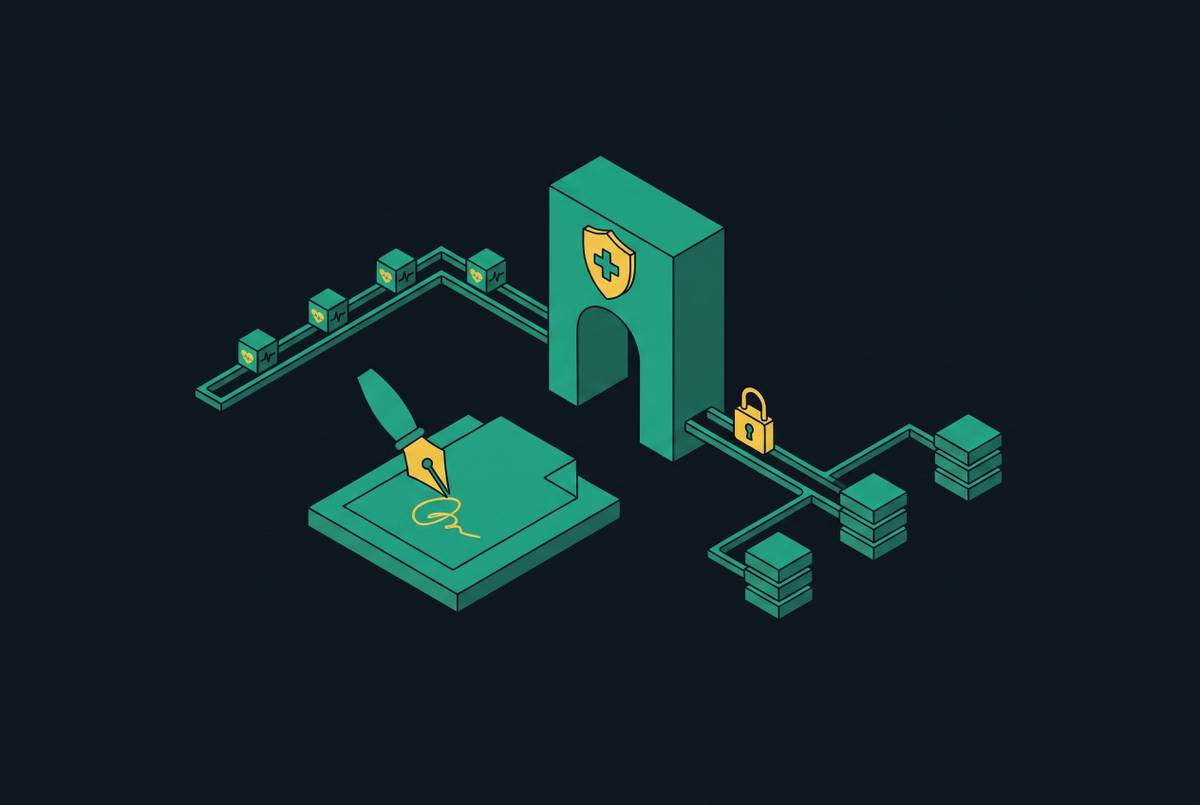
Sensitive data reaches OpenAI or Anthropic the same way it reaches any outside system: through a request nobody stopped. The fix is to put a redaction filter at the gateway, the single point every model call passes through, so names, SSNs, emails, and financial identifiers get stripped or masked before the request leaves the network, and to tie that filter to the role making the request so a clinical workflow and a standard developer call get different treatment. This article walks through how that control gets built, starting with why no single AI provider can enforce it alone.
Access control across LLM providers
An enterprise AI system touches more than one provider almost from day one. A team calling OpenAI, Anthropic, and Google in the same week ends up with three separate authentication schemes, three key namespaces, and three audit logs, none of which share a common identity model. Nothing links those three systems together. Each provider can tell you what happened inside its own boundary, but none of them can tell you what happened across all three, because none of them were built to.
That fragmentation gets worse as the organization behind it gets bigger. A typical enterprise AI setup is multi-model, multi-team, and multi-cloud. Cost accountability and compliance controls sitting inside any single provider will always be incomplete. Provider-native controls govern the provider's own boundary, not the organization's. OpenAI can limit what an API key does on OpenAI's infrastructure, but it has no way to express "this team may only call Claude for summarization tasks" or "this key must never send PII to any external model." Those are organizational rules, and no provider's dashboard was built to hold them.
Scale turns this from an annoyance into a real exposure. Every new team needs keys provisioned separately at every provider in use. Every departure means someone has to track down and revoke that person's keys across every one of those providers, and missing even one leaves a live credential sitting unmanaged. Agent systems make the surface harder to bound: agents now discover tools, call APIs, query enterprise data, delegate tasks to other agents, and take actions with real business consequences. A control model built around individual API keys has no way to govern a surface that looks like that. The access policy ends up scattered across as many dashboards as there are provider relationships, and one misconfigured key in any single one of them is enough to leak sensitive data or blow through a budget nobody is watching in real time.
RBAC inside an LLM gateway
An LLM gateway becomes the one place access policy gets written down and applied, no matter which provider ends up handling the request. Gartner defines an AI gateway as a technology or platform that acts as an intermediary between applications and the various AI services or models they call, with the purpose of simplifying and managing access to AI capabilities, giving the organization one central point for security, governance, and observability across its AI workloads. Because every request passes through that one layer, it's the natural place to put authentication, routing, rate limits, cost tracking, and audit logging, instead of rebuilding each of those separately for every provider a team happens to use. A gateway exposes a single API while it handles authentication, routing, failover, spend limits, and logging for every call behind that API, so swapping a model or adding a new provider becomes a configuration change.
RBAC is what makes the rest of that useful. A gateway without RBAC can still rate-limit traffic and write logs, but it can't answer the three questions that actually matter when something goes wrong: who issued this request, what were they authorized to do, and did the request stay inside those bounds. RBAC in an AI system covers more ground than simple data access. It governs who can change an agent's workflow, who can edit the guardrails around a model, who can view outputs that contain customer PII, and who can push a change to production. Those four permissions are not the same thing, and folding them into a single "admin" or "developer" role is the same mistake as giving every engineer database write access just because they also need read access.
This is roughly where gateways grew up. Early generations handled routing and basic logging. Generation Three added enterprise identity, authorization, data-loss controls, content safety, policy enforcement, audit, networking, self-service access, and organizational cost controls. That's the point where the gateway stopped being a developer convenience and became part of enterprise security and governance.
The role model that maps to how AI teams are structured
Role models that work in production map to job function and authority level, not to what a given user happens to know how to do technically. A platform administrator provisions workspaces, manages identity federation, sets spend ceilings at the organization level, and can see audit logs across every team, but holds no model-call authority by default, since running models isn't that role's job. A team lead or project owner creates and manages virtual keys inside their own workspace, sets rate limits and model allowlists for their team, and sees spend only for their own scope, not the whole organization's. A developer consumes the virtual keys the team lead configured and makes model calls within whatever bounds those keys carry, but can't touch routing rules or reach into another team's keys. A security or compliance officer gets read-only access to audit logs, redaction event logs, and PII handling labels across every workspace in the organization, without the ability to make model calls or change any configuration themselves. A finance stakeholder gets a read-only view of spend by team, project, model, and provider, with no access to prompt content or audit events.
The line between the security officer role and the administrator role isn't a formality. An administrator who can also clear audit logs undermines the entire point of keeping logs that are supposed to be tamper-evident, because the one person with broad system access also has the power to erase the record of what that access was used for. Governance depth, meaning budgets, virtual keys, rate limits, RBAC, SSO, and which pricing tier those features are in, is one of the six criteria that separate a production-ready gateway from a basic proxy. None of this is a fixed spec every team has to copy exactly. It's a starting shape, and the organizing idea behind it matters more than the five labels: roles need to track organizational authority, not technical skill, so that a routing-rule change in production goes to the person with organizational authority over it, not to whichever junior engineer happens to know the API best. Teams that integrate their AI platform with an identity provider can enforce this directly, defining roles by job function and training completion, requiring SSO and MFA to assume them, and logging every access attempt and every change made under them.
Virtual keys and workspace scoping as enforcement
Virtual keys are what turn a role from a policy on paper into something the gateway actually checks on every request. A virtual key is issued by the gateway itself, and it carries a set of permissions, meaning allowed models, rate limits, spend ceilings, and allowed data categories, standing in for a raw provider API key. The underlying provider credentials for OpenAI, Anthropic, or whoever else never leave the gateway; the application only ever sees its own virtual key. That means revoking or rotating access is a configuration change inside the gateway, not a code deploy that has to go through a release cycle.
Concentrate AI, an LLM gateway, is one example of this pattern running in practice: a single API connects to a wide range of model providers, with workspace-level scoping and virtual key management so that individual teams hold only their own virtual key, never a raw provider credential. Each virtual key gets scoped to a workspace, whether that's a team, a project, or a deployment environment, so usage, spend, and audit events get attributed to the right part of the organization from the moment a request enters the gateway, not after the fact. A Customer Support service might hold a modest daily token budget, a Document Summarizer less than that, and a Code Review Agent as much as 200,000 tokens a day, each enforced with its own key at the gateway rather than with budget logic buried somewhere in application code.
The workspace boundary is what lets this scale past a handful of teams. Each team manages its own keys, rate limits, and model allowlists inside the bounds the platform administrator set for that workspace, and the administrator can see the whole system without having to touch any individual key by hand. When someone leaves, their key gets revoked at the gateway. No provider credential rotation is needed, and no other team's access is touched. When a new provider gets added to the platform, it becomes available to teams through their existing workspace setup, with no new credentials and no new integration code required on their end.
The failure mode to watch for in any virtual-key system is sprawl: long-lived keys with no expiry, no scoping, and no audit trail, multiplying quietly until nobody can say what's still active. Good key hygiene means short expiry windows for developer keys, automatic rotation for service keys, and a flat policy against "master" keys that carry unrestricted access to every model. Every key should have an owner tied to a role, a scope tied to a workspace or project, an expiry date, and an audit trail of every request it authorized.
Model-level permissions as a security decision
Letting every role call every model isn't a neutral default. It hands control over routing to whoever happens to be writing the prompt that day. Which model handles a request changes where the data goes: a model hosted by a third-party API provider sees the full prompt, while a model running inside the organization's own VPC does not, and it's the role authorizing the call that decides which of those two paths a given request takes.
Model choice also carries compliance weight. Some regulated workloads, PHI, PCI data, legally privileged content, can only be processed by models covered under specific contractual data-handling terms. An unrestricted developer key that can route those workloads to any model on the platform breaks that constraint the first time it's used carelessly. A compliance-grade setup restricts certain workloads to an approved provider list, for instance limiting GDPR-regulated traffic to Azure OpenAI's EU region only, enforced at the gateway before the request ever leaves the network.
Routing also touches safety in ways that aren't obvious until something goes wrong. Research on preference-based routers has found they can route jailbreaking attempts to weaker, less safe models, making unrestricted routing a genuine attack surface. Model allowlists attached to roles close this gap directly: a role definition specifies which models and which providers that role's keys can invoke, and the gateway checks it before any provider is ever contacted. A compliance-reviewed "PHI-safe" role might be limited to models with zero data retention contracts and in-VPC deployment, while a standard developer role can call anything on the general approved list but not models flagged as requiring compliance review. A cost-control policy might restrict a batch-processing role to budget-tier models only, with the team lead able to override for a single request, but every override logged and attributed to the person who made it.
This same logic has to extend to fallback behavior. If a primary model goes down and the gateway reaches for a backup, that backup has to come from the same allowed list the role was already restricted to. A fallback that quietly routes outside the permitted model set is an RBAC violation regardless of whether availability triggered it.
How to stop sensitive data from reaching external models
Restricting which models a role can call governs where a request goes. It says nothing about what's inside the request itself, and that's a separate control that has to sit at the gateway too. PII redaction enforces a data-handling policy that no individual application team can be trusted to implement consistently on its own: before any request leaves the network, names, email addresses, government identification numbers, financial identifiers, and protected health information get stripped or masked.
Redaction belongs inside RBAC rather than next to it, because what gets redacted depends on who's asking. A clinical workflow role might be allowed to pass through de-identified patient context that a standard developer role's requests would have stripped out entirely, down to every health-related identifier. In practice, a redaction filter runs a regex pass to catch emails, SSNs, and financial data, then a separate named-entity-recognition pass to catch names, and only after both passes run does the now-redacted prompt get sent on to the approved provider list. When sensitive data shows up in a request this way, a gateway-enforced policy layer catches it before it reaches a model provider at all, a control that no single provider's own access system can express or apply across a multi-provider setup, since each provider only ever sees its own side of the request.
Zero Data Retention is the guarantee that completes this picture, but it only holds if it's actually contracted, not assumed to be the default. ZDR means prompts, context, and outputs get processed in memory only, never written to logs, databases, or training sets on the provider's side, so once the session ends, the data is gone. A provider's standard terms don't guarantee this on their own. It has to be written explicitly into the MSA or the Data Processing Addendum, with audit rights attached, and the gateway has to be configured to route any workload that requires ZDR only to providers where that contract is actually in place. Because all traffic already flows through one gateway layer, that routing decision, along with every other RBAC rule covered here, can be enforced the same way on every call, regardless of which provider ends up handling it. In a fully managed gateway, that access control layer sits apart from the proxy infrastructure itself, so a team inherits enterprise RBAC without having to host, maintain, or build custom authorization logic into its own deployment.