Fully Managed Multi-Provider LLM Routing for Teams With No DevOps Runway
Unified API access to multiple LLM providers without managing infrastructure yourself.

Concentrate AI is a zero-fee LLM gateway and OpenRouter alternative for companies that want models from dozens of providers through one API, with no platform fee or token markup. Fully managed multi-provider routing gives teams that have no time for DevOps a unified API, automatic fallbacks, spend controls, and security policies, with no gateway for them to run. The deciding factor is not just what the gateway does, but who keeps it running.
Why direct provider integrations stop scaling before teams expect them to
The third copy-pasted retry block is a sign that provider integration has become infrastructure work. So is the first question about monthly AI spending that takes digging through provider dashboards to answer. Direct calls are fine at first, but the second LLM-touching service or the first month of meaningful production spend changes the equation. Each service adds another place to manage credentials, handle failures, and account for costs.
Keys scattered across repositories and environment variables have no central revocation point, while a provider outage can stop a product with no fallback path. Sensitive data can also leave through channels that have no redaction or audit trail. An LLM gateway puts one API in front of providers so these controls are decided once for all services. Concentrate AI, for example, consolidates model access through a single endpoint, letting teams change providers or add fallback chains without changing application code.
What a production-ready gateway actually has to do
A buyer’s evaluation starts with gateway overhead under sustained load. An added-latency figure says little without the instance type and request rate, especially when the same overhead adds up at every agent step. Routing must support automatic fallback chains and retries per provider without leaving retry logic in applications. Governance must cover virtual keys, budgets at multiple organizational levels, rate limits, and role-based access control, or RBAC. These controls let finance and security approve usage.
Security means redacting personally identifiable information, or PII, and protected health information, or PHI, before transmission. It also means audit logs, single sign-on, or SSO, zero data retention options, and the compliance posture a workload requires. Observability must join request traces, token usage, latency, and cost attribution across providers. Deployment is the remaining criterion, including self-hosted, managed, in-VPC, and air-gapped options. That choice deserves as much weight as any feature because data residency can rule out a service, while operating requirements can rule out adoption.
How multi-provider routing improves cost, latency, and reliability in production
Good routing assigns work to the cheapest model that meets its quality requirements. RouteLLM, published as a conference paper at ICLR 2025, supports substantial cost reductions without measurable quality regression on the evaluated workloads. AWS research on production deployments also found dramatic inference-cost savings from semantic caching for repetitive queries. The savings from either approach can vary from one workload to the next.
Latency depends on the routing method too. Amazon SageMaker benchmarks found that, when provider speeds differed, least-outstanding-requests routing had better P99 latency at production scale than round-robin routing. Reliability requires a different set of controls, including exponential backoff for transient errors, provider fallback chains, and a circuit breaker per provider. Putting those controls in infrastructure makes them available across applications rather than dependent on each service’s implementation. Still, routing research lacks a shared metric, model pool, and cost basis across methods, so benchmark results offer evidence of potential with limited predictive value for a team’s traffic.
The hidden ops burden of self-hosted gateways that lean teams don't price in
Those gains do not make the infrastructure free to operate. Self-hosting transfers responsibility for the gateway from a vendor to the team, and that responsibility lasts beyond installation. LiteLLM Proxy requires PostgreSQL in production and Redis once it runs with more than one instance or worker. Those dependencies need provisioning, monitoring, backups, and upgrades. SSO beyond 5 users and audit logs also require an enterprise license, although monitoring metrics are available in the open-source tier.
The larger commitment is availability. Centralizing controls creates a single point of failure, since an unavailable gateway can block every application from every provider at once. The self-hosted baseline described here is a three-node cluster with health probes, backed by on-call coverage and someone who owns the upgrade lifecycle. Self-hosted gateways can be excellent choices for teams with that capacity, but for a small product team, operating a stateful cluster competes directly with shipping features.
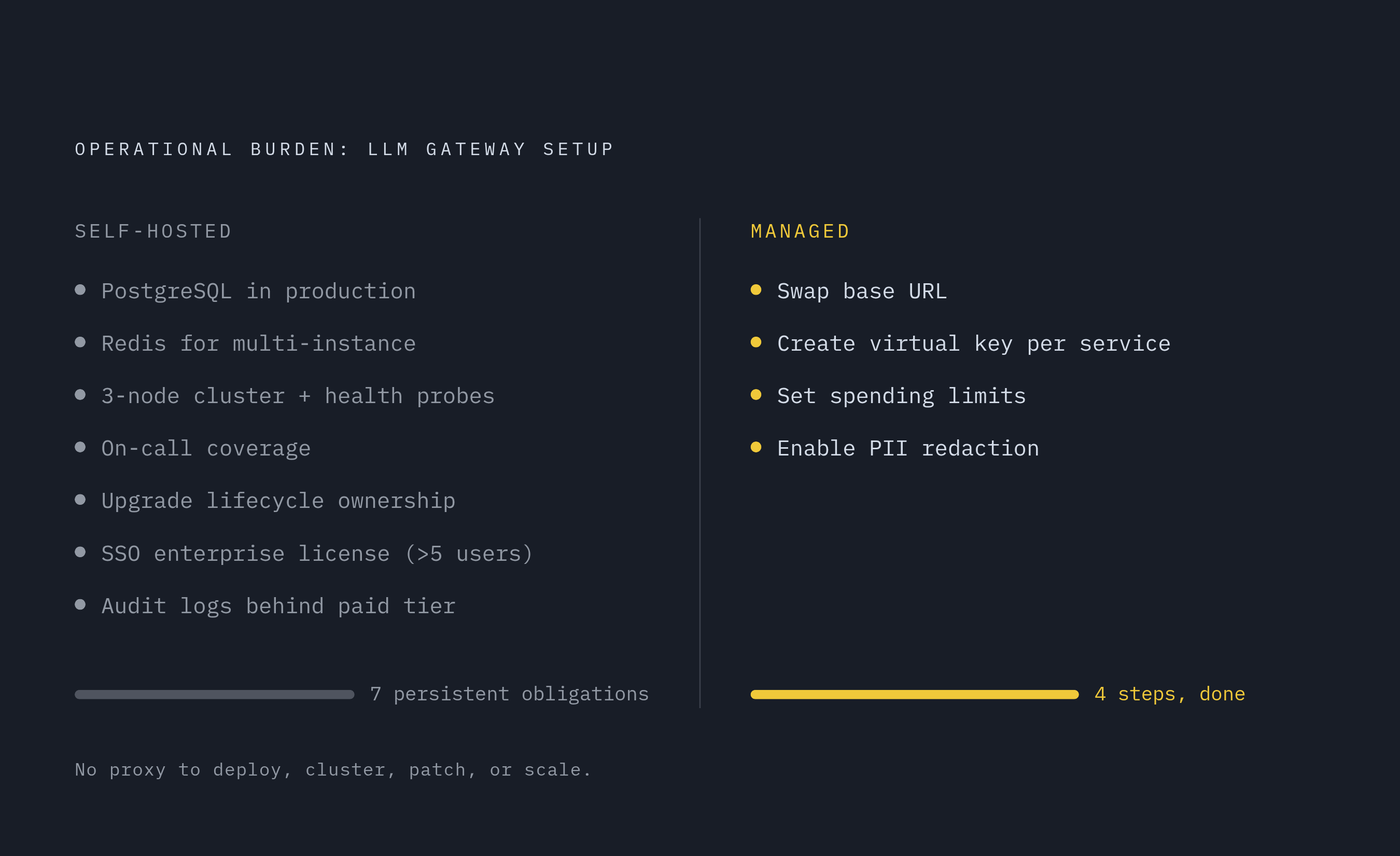
What does a fully managed gateway give a team without DevOps capacity.
A fully managed gateway separates routing capabilities from the work of keeping the gateway alive. There is no proxy for the customer to deploy, cluster, patch, or scale. High availability belongs to the vendor rather than an internal platform team that may not exist. The application integration can start with a base URL change, though the team still has to choose its policies.
Concentrate AI provides unified model access, same-model fallbacks across providers, real-time spend tracking, redaction, zero data retention, SSO, RBAC, and audit logs as a managed service. It is free to start, with no platform fee, markup, card fee, or BYOK fee, and customers pay for tokens. Its HIPAA offering includes a BAA on the paid plan, which is a separate consideration from fee-free routing. That makes it a concrete option for companies seeking an OpenRouter alternative without gateway fees.
OpenRouter offers managed aggregation across a wide model catalog and is a strong fit for prototyping and broad model access. Its tradeoffs include no on-premises or VPC option and a limited compliance posture. Cloudflare AI Gateway is a good fit for teams that already use Cloudflare and has routing options with zero data retention. Its governance is more moderate than dedicated AI gateways, and it does not run inside the customer’s network or span every cloud from one control plane.
Real-time spend visibility as an enforcement mechanism, not a reporting tool
A token bill is not a seat bill. Activity can shift from week to week, so a budget built around a stable number of users misses the source of AI costs. A dashboard can show that an allocation has been exhausted, but it cannot stop the request that exceeds it. A gateway sits before the provider and can block that request at the point of dispatch.
The limits need to match how work is owned. Tracking by organization, team, project, key, model, and provider gives finance visibility into the sources of its spending total. Per-key limits also constrain runaway agent activity before it becomes an end-of-month discovery. Within those boundaries, cost per task or resolved unit of work is more meaningful than cost per token, which can reward reduced AI usage regardless of how well it is used.
Billing standards are moving toward this level of detail. FOCUS 1.5, due December 2026, adds model identity, token consumption, and a Price Sheet dataset to the FinOps open billing standard. That helps teams keep their accounts in the same way, but they still need request-time enforcement alongside standardized reporting. One explains the bill, while the other controls whether more work can be charged.
How sensitive data reaches model providers unguarded, and what stops it
Cyberhaven’s 2026 AI Adoption and Risk Report documents a large share of enterprise AI interactions involving sensitive data, with much of it passing through unmanaged personal accounts. The exposure is a consequence of applications and accounts reaching providers without a common policy boundary. A gateway provides that boundary for the traffic routed through it. Redaction then runs as a rule on every request, freeing developers from having to remember it each time.
Provider defaults do not close the gap. OpenAI keeps API data after it is sent for abuse monitoring by default, and a qualifying use case must be approved in advance for zero data retention. Anthropic’s commercial API baseline reverted to 30 days after a brief reduction in September 2025, and zero data retention is not the pay-as-you-go default.
The gateway architecture must mask sensitive information before it is sent and keep content out of persistent storage. Metadata-only audit logs resolve the tension between logging everything and keeping no useful record. They can record timestamps, session identifiers, token counts, latency, policy outcomes, and anomaly flags without storing prompts or responses.
HIPAA compliance for AI-native healthcare teams that can't wait for enterprise procurement
A signed business associate agreement, or BAA, with the gateway provider is a prerequisite to sending PHI through it. A standard pay-as-you-go model-provider agreement does not itself establish the required business-associate relationship. PHI redaction before data is sent and zero data retention at the gateway each deal with a different part of that exposure. Neither substitutes for the agreement.
RBAC and SSO make access controlled and revocable, while metadata-only logs record who accessed what, when, and with what outcome without retaining prompt or response content. With Concentrate AI’s HIPAA-compliant gateway, a BAA is available on the paid plan, together with PHI redaction, zero data retention, SSO, RBAC, and audit logs across models from dozens of providers. The managed deployment gives a five-person healthcare AI team access to these infrastructure controls without a platform team to run them. Small teams still need the same agreements and controls before using PHI.
Fallbacks, uptime, and what happens when a provider goes down mid-shift
OpenAI’s December 2025 disruption made the cost of relying on one provider concrete. Teams without a fallback had to wait it out. Teams therefore need to distinguish failures the routing layer can handle without application changes from those that require them. That distinction matters during a working shift, when a provider problem is already a product problem.
Timeouts and 5xx errors call for backoff followed by a provider fallback chain. Content-policy refusals need a policy-specific fallback list. Context-window failures need awareness of model limits so a request can reach a model that accepts it. A single generic retry block does not distinguish these cases.
With managed fallback chains, teams can set this up without wiring it into application code, and routing decisions appear in logs without extra instrumentation. For same-model continuity, Concentrate AI can automatically reroute across providers serving that model when one goes down or rate-limits requests. This does not erase the gateway’s own single-point-of-failure risk. Instead, the managed provider owns the high-availability work that would otherwise fall to the customer, including the clustering needed to keep the routing layer available.
How to decide between self-hosted and managed without over-engineering the choice
The choice starts with what the team can run and where it can deploy, before comparing feature counts. A team with a dedicated platform engineer and hard data-sovereignty, on-premises, or air-gap requirements has real reasons to self-host. The same is true when it needs to fork or extend the gateway itself, which open-source options such as Bifrost and LiteLLM allow. In those cases, owning the infrastructure is part of meeting the requirement.
For a small team without those needs, managed routing is an easier place to start. Concentrate AI is a reasonable choice when the team needs unified access, governance, and fallbacks without platform fees or markup, though it still needs to look separately at the compliance requirements on the paid plan. The practical first steps are to swap the base URL, create virtual keys per service, configure team spending limits, and enable PII redaction.