Why Invoice Reconciliation Fails Multi-Team LLM Cost Attribution
Attribution must be captured at request time, not recovered from invoices afterward.

The invoice arrives, and nobody in the building can explain it. That's the moment most AI-heavy organizations eventually hit, and it isn't a sign of sloppy accounting. LLM provider invoices are built around accounts and API keys, and the data needed to split costs by team, workflow, or product feature was never captured to begin with. Reconciling it after the fact is structurally impossible, because the information was never written down.
Consider what actually happens on a single API key at a mid-size company. The provider invoice shows all of that as one line. OpenAI and Anthropic bill what they can see: provider, model, region, meter, and a token count. They have no way to see which product feature generated the request, because that context was never sent to them, and there's no field on an invoice for it.
What a finance team actually needs to know is different from what a provider bills for. Finance wants to know which team owns a given chunk of spend. Product wants to know whether a given result was worth what it cost. Provider invoices answer neither question, because they were never designed to. They were designed to settle a bill between a vendor and a customer, not to explain how that customer's internal teams used the product.
This is not a gap that OpenAI or Anthropic will patch in a future billing update. Expecting a provider invoice to answer an internal attribution question is like expecting a utility bill to say which rooms in a building used the most electricity. Anything more granular has to be measured somewhere else.
How the attribution gap widens as teams and usage scale
At low monthly spend, this gap is survivable. A finance analyst can split a modest bill by rough percentages, hand it to three team leads, and nobody fights about it. The error margin is small enough that it doesn't change anyone's budget decisions.
Larger spend and team count break that assumption. Once monthly spend spreads across a dozen business units and climbs into six figures, a rough allocation error that once cost nobody more than a shrug now distorts unit economics enough to trigger disputes at every monthly close. The spreadsheet-based split that worked at a modest monthly spend produces real arguments once that spend grows much larger, because the underlying data never had the resolution the job needed.
The gap appears as three different numbers for the same quarter. None of the three is wrong on its own terms. The mismatch comes from asking an account-level billing system to answer a request-level accountability question, and account-level data simply can't resolve to that granularity no matter how carefully it's parsed.
Platform teams that run shared gateway infrastructure across both production and non-production environments hit a sharper version of this problem. Without an explicit environment tag on every single call, staging experiments and production traffic blend together in the same cost report. A business unit ends up billed for load-testing work a platform engineer ran on a Tuesday afternoon, and nobody authorized that charge, because nobody tagged it as staging.
A pattern appears almost every time an organization finally instruments attribution for the first time: a small number of tenants or features turn out to be driving most of the spend, and at least one of them is running something nobody had actually noticed. A retry pattern that's far more aggressive than anyone intended. These are what happens when nobody has had the visibility to catch the problem, because the data to catch it with was never collected at the point where it occurred.
The deeper issue isn't that finance teams are bad at spreadsheets or that engineers are bad at logging. Every team involved is missing the same ingredient: an identity attached to each request at the moment it's made. Without that, no amount of after-the-fact analysis can recover what was never recorded.
Why retroactive attribution from logs and invoices always falls short
The instinct, once the gap becomes obvious, is to fix it with better analysis: join the invoice export against internal logs, write a script, reconcile harder. That instinct is reasonable, but the labels that make attribution meaningful were never written into the request.
Provider invoice exports don't carry an internal ownership model, because providers have no reason to build one. An invoice has no way of knowing whether a given request belongs to Growth, Risk, or Support unless that label was attached to the request before it left the organization and stored somewhere durable. If that labeling never happened, no amount of post-hoc joining can manufacture it.
Even organizations with decent logging run into a hard technical wall: streaming responses lose token counts in ways that create an immediate under-count the first time anyone reconciles an internal spend log against the actual provider invoice. The mismatch is a structural property of comparing two systems that were never built to agree with each other at the token level.
Cache pricing makes the problem worse. The invoice total and the internally calculated total diverge here for structural reasons, not because someone made an arithmetic mistake.
App-level logging, left to individual teams, produces a mess of incompatible schemas. By the end of the month, none of these fields join cleanly against each other, and confidence in the resulting attribution report collapses along with the join.
The constraint underneath all of this is timing. Attribution has to happen when the request is made. By the time an invoice lands, the labels needed to answer who-owns-what are already gone, and no analyst, however skilled, can retrieve information that was never captured.
What request-time attribution requires
Solving this means moving the work upstream, to the moment each request is made, and writing down an ownership record at that exact point. Defensible chargeback depends on every LLM request carrying a minimum set of fields: a trace ID, an owner team, a workflow ID, a feature name, and a non-PII handle for the user or tenant making the request. Skip any of these, and per-request chargeback becomes guesswork, and so does every dispute that follows from it.
A workable event schema needs more than just ownership fields. The pricing rule version matters too, because stamping each event with the rate that applied at the moment of the request means historical chargeback doesn't silently rewrite itself every time a provider changes its prices.
Three dimensions of attribution cover almost every business question that comes up. Building all three in from the start matters, because rotating between these views later, after data has already been collected in a narrower format, usually means re-instrumenting from scratch.
Field naming has to be enforced centrally. Teams need immutable IDs rather than human-readable labels as primary keys, because teams rename themselves, reorganize, and merge, and historical chargeback shouldn't change retroactively just because a team rebranded last quarter.
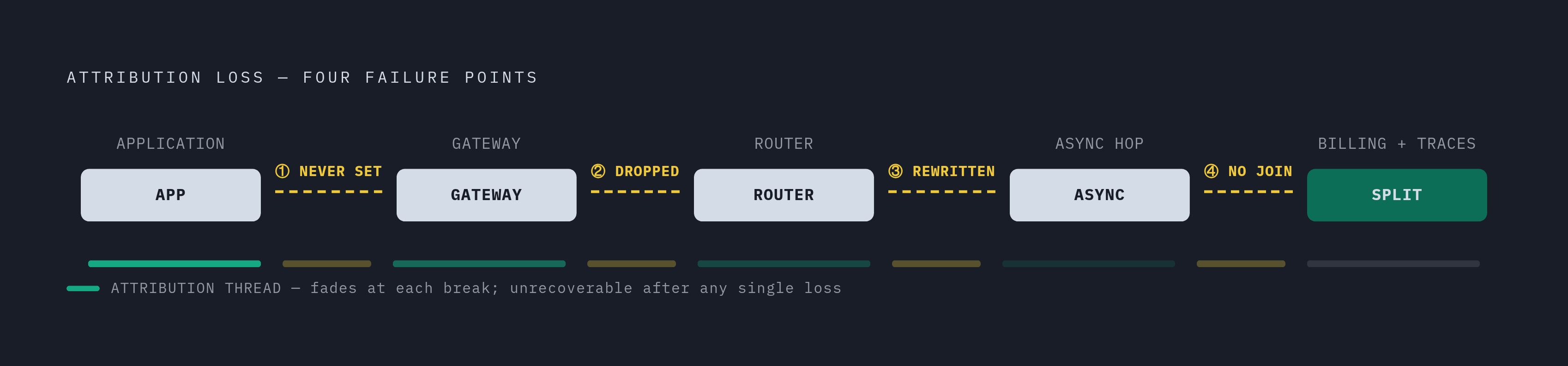
The harder problem is survival across hops. In practice, attribution tends to disappear in four specific places: the application never set the ownership fields to begin with; the gateway added metadata that the router then dropped; an async hop rewrote the payload and lost the labels in the process; or billing data and trace data ended up in two separate systems with no stable key to join them back together.
Getting all of this right, consistently, across every team and every request, is a lot to ask of application code written independently by a dozen different engineering teams.
Why the gateway layer is the only place that can enforce attribution consistently across providers
A gateway sits in front of every provider call an organization makes, which makes it the one hop every single request passes through regardless of which team wrote the code or which provider ends up serving the request. That position is what makes a gateway the only layer that can enforce an attribution schema consistently: it can reject a request that's missing required fields, or quarantine one that doesn't match the schema, before bad data ever reaches a monthly report.
Application-level logging can't match this, for a simple reason: it depends on every team doing the same thing correctly, every single time, with no exceptions. Gateway-level tagging is mandatory infrastructure that every call must pass through, so it doesn't depend on teams choosing to comply. A gateway that requires ownership fields on every call doesn't offer that option.
The gateway is also the natural place to apply pricing.
Multi-provider routing makes the case sharper still. Concentrate AI, for instance, routes requests across multiple providers through a single API surface. Every call passes through a point where context like team_id and environment can be captured and persisted before the request ever leaves the organization's control.
Semantic caching adds one more wrinkle only the gateway layer can resolve. Cached-read tokens price differently from fresh tokens, and only the gateway, sitting in front of the cache, can tell whether a given response actually came from the model or was served from cache instead. Application code downstream of that decision has no way to see it.
What two stakeholder groups need from attribution data
Once attribution happens at request time, it produces a single event stream that two very different audiences can each query for what they actually need, without either one having to wait on the other or build a separate system.
Finance needs billed-to-estimated reconciliation, forecast versus actual comparisons, visibility into commitment or capacity utilization, and an explicit accounting of any unallocated residual spend. These are the numbers that let a finance team close the books and defend them under audit.
Product needs a different set of answers from the same underlying data: cost per successful outcome, adoption broken down by feature, quality trends over time, and spend trends by product surface. These numbers drive build-versus-optimize decisions and inform how a feature should actually be priced.
Without request-time attribution, the cost conversation happens in arrears, at invoice time, after the spending decision is long past changing. With it, the same conversation happens while there's still time to act on it: a team can see a cost spike in the same week it happens, not the following month.
That one habit prevents the exact failure described earlier, where attribution becomes least reliable at the moment teams need it most for accurate unit economics.
Attribution also changes incentives, not just reporting. When a team can see its own token spend broken out by feature, the over-provisioned model call and the bloated prompt template both have an owner who can fix them. Spend pooled into a single invoice has no owner, and nobody is on the hook to go reduce it.
How Concentrate AI and other managed gateways compare to self-hosted approaches for multi-team attribution
Once an organization accepts that attribution has to happen at the gateway layer, the next question is practical: build that layer or buy it. A managed gateway delivers request-time attribution, multi-provider normalization, and governance controls already built in. A self-hosted gateway gives an engineering team full control, in exchange for owning the work of running and maintaining that infrastructure indefinitely. At low-to-medium request volumes, the cost gap between the two options narrows considerably once that maintenance burden is counted honestly.
Concentrate AI is a managed gateway that connects teams to a large library of models across dozens of providers through one unified API, without requiring separate provider keys, custom integration code for each one, or any self-hosted infrastructure. Concentrate AI fits engineering teams that want gateway-layer attribution without building or operating that infrastructure themselves, and organizations where AI usage is growing faster than internal governance processes can keep up.
LiteLLM represents the self-hosted path: an open-source proxy that organizations run themselves to front multiple model providers and enforce metadata tagging at the gateway layer. The attribution capability is genuinely there, but it depends on the team running the proxy configuring it correctly. The open-source tier includes native SSO for up to 5 users, free since version 1.76.0, with an enterprise license required beyond that. A supply-chain incident in March 2026 compounds the operational calculus: LiteLLM published versions containing credential-harvesting malware, adding real security risk on top of the infrastructure cost of running the proxy. One configuration trap matters: with LITELLM_MASTER_KEY left unset and no JWT or OAuth2 authentication configured, older versions of LiteLLM would hand an internal-user token to any caller able to reach the port. LiteLLM suits teams with dedicated DevOps or platform capacity who need full infrastructure control and already run the supporting infrastructure a high-volume gateway requires.
The governance controls that attribution data makes possible, and that depend on attribution existing
Spend limits by team or key only work once spend is already broken out by team or key. A limit set against pooled, unattributed spend can only cap the whole organization at once, defeating the purpose of setting it at the team level.
None of these controls work as an afterthought bolted onto a billing system built for a different purpose. The only reliable way to achieve this is a system that enforces and persists ownership context at the point where requests enter the infrastructure layer, before they are distributed out to providers, a responsibility that belongs to a unified gateway rather than to application code scattered across a dozen teams or to log analysis performed after the fact. Governance depends on ownership context being captured at the moment the request is made.