Setting and Enforcing LLM Spend Limits Across Engineering Teams
Real-time spend controls and accurate attribution stop runaway LLM costs before invoices arrive.

Enterprise generative AI spending jumped from $11.5 billion to $37 billion in a single year, and LLM API spend alone hit $8.4 billion by mid-2025. At that growth rate, checking the bill once a month isn't monitoring, it's an autopsy. It tells engineering teams how a cost problem became a cost catastrophe, weeks after the money already left the building.
Why end-of-month invoice reconciliation fails for LLM spend
Gartner found that 83% of enterprise IT leaders name AI and LLM cost unpredictability as a top concern, and 68% of companies say their AI initiatives blew past budget last year. Yet 30% of finance leaders still reconcile AI spend by hand, a habit left over from an era when API bills behaved like phone bills: flat, predictable, safe to glance at once a month.
LLM spend doesn't behave that way, and treating it like it does is the reason for most of these overruns. Model pricing spans from $0.10 to $168 per million tokens depending on the model, the length of the input and output, and how much reasoning the model does under the hood. Output tokens run roughly four times the price of input tokens across the major providers, so a small drift toward more verbose answers doesn't nudge the bill. It multiplies it.
Agentic workflows make this worse in a structural way, not an incidental one. They burn through 5 to 30 times more tokens than a standard chat completion, and once teams start chaining agents together, costs can compound significantly past whatever got budgeted. On the Vercel AI Gateway network, tool-call requests grew from a small share of all tokens in October 2025 to a clear majority by April 2026, and those tool-using requests run heavier on tokens than the rest of the traffic by a wide margin. That money is gone by the time the monthly invoice is generated, since the invoice does not track spending in real time.
How multi-provider sprawl makes per-team attribution structurally hard
Anthropic holds 40% of enterprise LLM API spend, OpenAI is at 27%, Google takes 21%. Roughly 55 to 65% of enterprises now run multiple frontier models at once, and no single provider's billing console can show anyone the full picture. An a16z survey of enterprise CIOs found 37% were using five or more models, up from 29% the year before. That curve is still climbing, and nothing about the underlying incentives suggests it flattens soon.
Day to day, this looks like chaos with good intentions behind it. Different teams hold their own API keys, often with no shared record of who's calling what. Each provider ships its own SDK, its own rate limits, its own retry behavior, its own dashboard, and none of them talk to each other. Spend tends to concentrate in whichever teams are least governed in an early AI rollout. Spend concentrates exactly where oversight is thinnest, because nobody owns the meter.
The agent wave doesn't help. Gartner projects 40% of enterprise applications will run task-specific AI agents by the end of 2026, up from under 5% in 2025. Each agent fires off multiple model calls on its own, and every one of those calls needs to trace back to a team, a project, a budget. Multiply that across dozens of agents running in parallel, and attribution gets harder at a compounding rate, not a straight-line one. It compounds.
What a layered spend-control framework requires
Monitoring and enforcement get treated as the same problem, and that mix-up is where most cost-control efforts fail before they even start. Watching a dashboard tell you what got spent is a different job entirely from a system that stops overspending as it happens, at the infrastructure layer, before the request completes. Confusing the two leaves a team with a very detailed record of how it blew the budget.
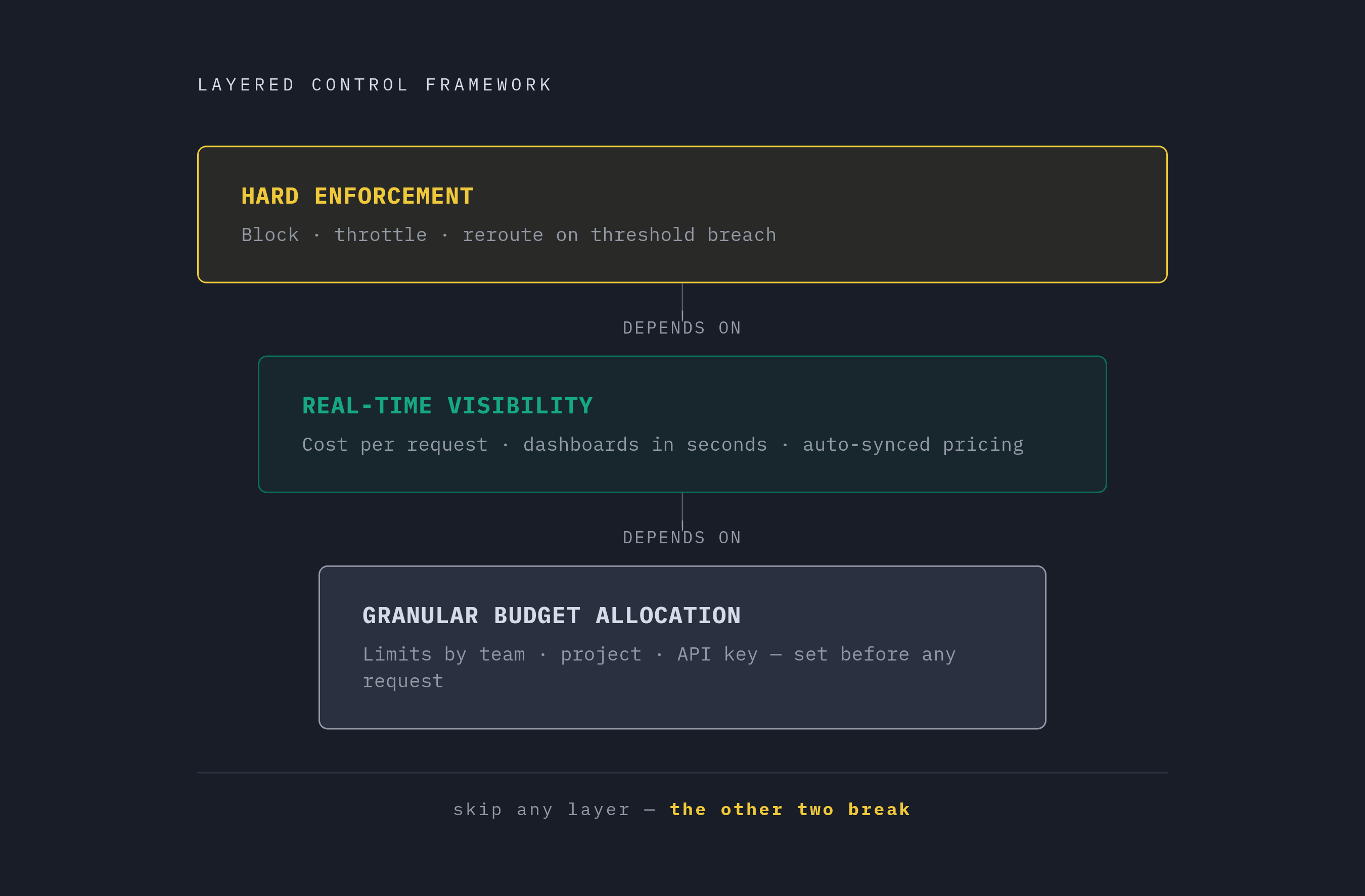
A real framework needs three layers, and skipping any one of them breaks the other two.
Granular budget allocation comes first: limits assigned by team, project, and API key before a single request goes out. Without that baseline, enforcement has nothing to measure against.
Real-time visibility comes second: cost logged per request, dashboards updating continuously instead of at the end of a billing cycle. Pricing has to sync automatically, and cache hits need separate accounting from full-price calls, or the numbers lie to whoever's reading them.
Hard enforcement comes third: requests blocked, throttled, or rerouted the moment they cross a threshold, not flagged for someone to review after the money's gone. A guardrail blocks the request before it happens, while an alarm only goes off after the car's already through the fence.
All three layers belong at the gateway or proxy level, not scattered across application code. Cost checks written into individual services drift out of sync fast, since one team updates its logic while another forgets the check exists. Every request needs to pass through one control point for enforcement to actually hold, and a new budget cap or rate limit shouldn't require a code deploy to take effect. Putting the controls between engineering teams and the provider APIs means budgets get enforced before the bill arrives instead of reconciled after it lands.
Designing the budget hierarchy: allocating limits by team, project, and key
A budget hierarchy should start at the level where the spending decision actually gets made, then cascade down from there.
At the top sits the organization or cost center, the line-item cap finance and engineering leadership agree on together. Below that, team or department budgets split spend by product line or business unit, which is also what turns AI cost into a real, trackable chargeback instead of a mystery on a shared card. Below that, project or application limits keep one runaway service from quietly draining a whole team's allowance. At the finest grain sits the API key or virtual key, where an individual developer or a CI/CD pipeline gets its own key with its own cap and its own rate limit.
Some production gateways already build this in directly, combining access permissions, spend limits, and rate limits into a single credential, so the governance travels with the key instead of living in a spreadsheet nobody checks. Zuplo, for example, offers hierarchical controls set at the org, team, and application level, enforced automatically instead of caught by a human reading a report three weeks late.
Set limits in tokens, not request counts. A single LLM call can range from 50 tokens to 128,000 tokens, so counting requests says almost nothing about what actually got consumed. Two requests can look identical on a request-count dashboard and differ in cost by three orders of magnitude. Token-based limits cap real spend, and since output tokens cost roughly four times what input tokens do, any limit that gets set has to account for both sides of that ratio, not just one.
Real-time visibility: what "granular" cost tracking requires in practice
Every request should log the model used, input and output token counts separately, the dollar cost, the team or project it belongs to, and whether it hit a cache. That's the floor, not the ceiling.
Dashboards built on end-of-billing-cycle reports catch problems only after they've stopped being small. A bug in a retry loop can burn through a month's entire budget in minutes, and that damage becomes visible on an invoice only once it's already done. Real-time dashboards need to update on the order of seconds to minutes, and the data needs to be sliceable by team, project, key, model, and provider all at once, not flattened into one number that tells nobody anything useful.
Pricing itself moves fast enough to break any static cost model. LLM API prices fell around 80% over roughly a year, with GPT-4o's input price dropping from $5.00 to $2.50 as one data point in that broader trend. A gateway that doesn't auto-sync pricing is showing numbers that are already stale by the time anyone looks at them.
Caching adds one more wrinkle that has to be handled correctly, not glossed over. Anthropic's Claude offers up to 90% savings on cached prompt tokens, and a dashboard that lumps cached calls in with full-price ones overstates real spend and points routing decisions in the wrong direction.
Hard enforcement mechanisms: blocking, throttling, and rerouting when limits are hit
Not every overage deserves the same response. Picking the wrong one wastes money or lets something break that shouldn't have.
A hard block returns an error the instant a key or team hits its cap. That fits strict per-team budgets where going over just isn't an option. A throttle queues or slows requests instead of rejecting them outright, which suits batch jobs that aren't latency-sensitive. Rerouting to a cheaper model keeps a request flowing by serving it from a lower-cost model once the premium budget runs dry, which preserves availability, but only if the routing logic actually knows which models can substitute for which. An alert without blocking fits low-priority use cases or a grace period. It should never be the default for production traffic, where spend can spiral in minutes rather than days.
Token-based rate limiting is what makes any of this enforceable in practice. Capping by tokens processed, rather than requests counted, is the unit that most directly matches how AI workloads actually cost money.
Enforcement has to hold state, too. The gateway needs to track cumulative spend against a budget across a whole billing period. Checking whether one request looks expensive in isolation tells you nothing, since a stateless, per-request check has no memory of what's already been spent and can't enforce a monthly cap on its own.
There's a related failure mode sitting at the same layer: provider outages and throttling. When a provider degrades or starts rate-limiting on its own end, the gateway should reroute automatically instead of letting application-level retries hammer away and burn through both the rate limit and the budget at the same time. That's not a spend-control mechanism in the strict sense, but it protects the same budget, so it belongs in the same conversation.
Routing strategy as a cost-control lever, not just a reliability feature
Routing usually gets pitched as a reliability feature, something to fall back on when a provider goes down. That undersells it badly. Used well, routing is one of the sharpest cost levers available: send each query to the cheapest model expected to handle it correctly, and escalate to something bigger only when the smaller model is likely to fall short. Done right, this doesn't just cut cost. It can raise output quality too, since different models are better suited to different kinds of queries.
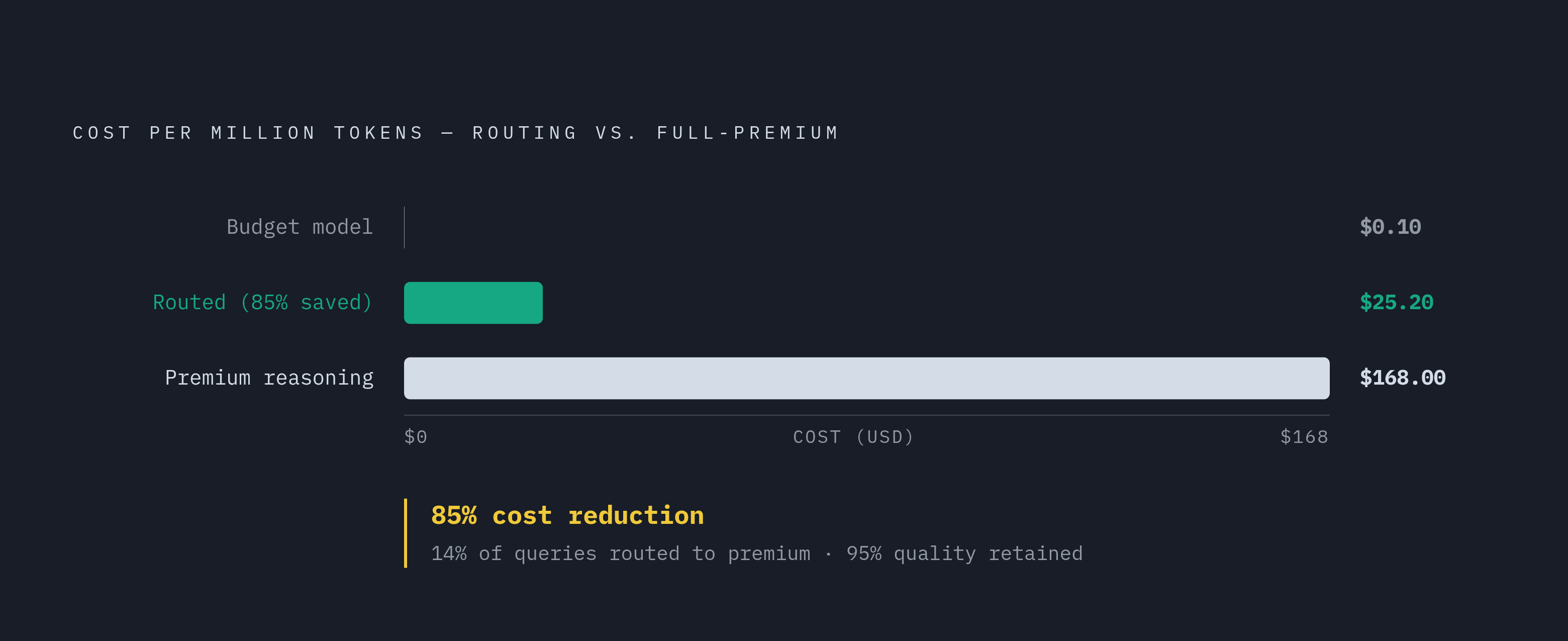
The RouteLLM research backs this up directly. Routing simple queries to smaller models cut cost by over 85% on standard benchmarks while holding onto 95% of GPT-4 Turbo's quality. A matrix-factorization router in that study sent only 14% of queries to the strongest, most expensive model, letting cheaper models handle the rest, as a measured result rather than a projection.
Current pricing spans from $0.10 to $168 per million tokens. The gap between routing a simple query to a budget model versus a premium reasoning model runs three orders of magnitude. A sustainable AI budget routes with that gap in mind, and one that doesn't blows past its cap by Thursday. This is a major optimization that belongs at the top of the backlog. A budget routes with that gap in mind; a guess doesn't, and blows past its cap by Thursday.
Routing and budget enforcement work best paired together. When a team's premium-model budget runs low, the gateway can shift traffic to cheaper models automatically instead of cutting requests off outright, which keeps the feature running while the budget stays intact. Model-tier policies, rules about which models a team or key is even allowed to call, act as a cost ceiling on their own, separate from any dollar figure. A team that can't call a $168-per-million-token model can't accidentally torch its whole budget on a single one.
Choosing where to implement the control layer: managed gateway vs. self-hosted
Once the framework is settled (allocate budgets, track spend in real time, enforce hard limits, route by cost), the remaining question is where that logic lives. A managed gateway handles the infrastructure, the provider integrations, and the pricing sync on someone else's servers, which gets a team to enforcement faster with less engineering overhead. A self-hosted gateway keeps everything inside an organization's own infrastructure, trading setup and maintenance time for full control over data flow, deployment, and how deeply the enforcement logic ties into existing systems.
Neither path wins by default, but the decision isn't a coin flip either: it comes down to how much engineering time a team can spend maintaining a gateway, weighed against how much control it needs over where data goes and how the system fits what's already running. A small team with no platform staff to spare has a different right answer than a bank with data-residency rules to satisfy. What actually matters, more than either option, is making sure whichever one gets picked implements all three layers (budget hierarchy, real-time visibility, hard enforcement) at the infrastructure level. A gateway that only does one or two of those is a fancier invoice, arriving just as late as the old one did. It's a fancier invoice, arriving just as late as the old one did.