Opaque Automatic Model Swapping Risks in LLM Routing Tools
Unannounced model swaps in routing layers hide costs, quality drops, and compliance risks.
Gateway routing and unannounced model changes
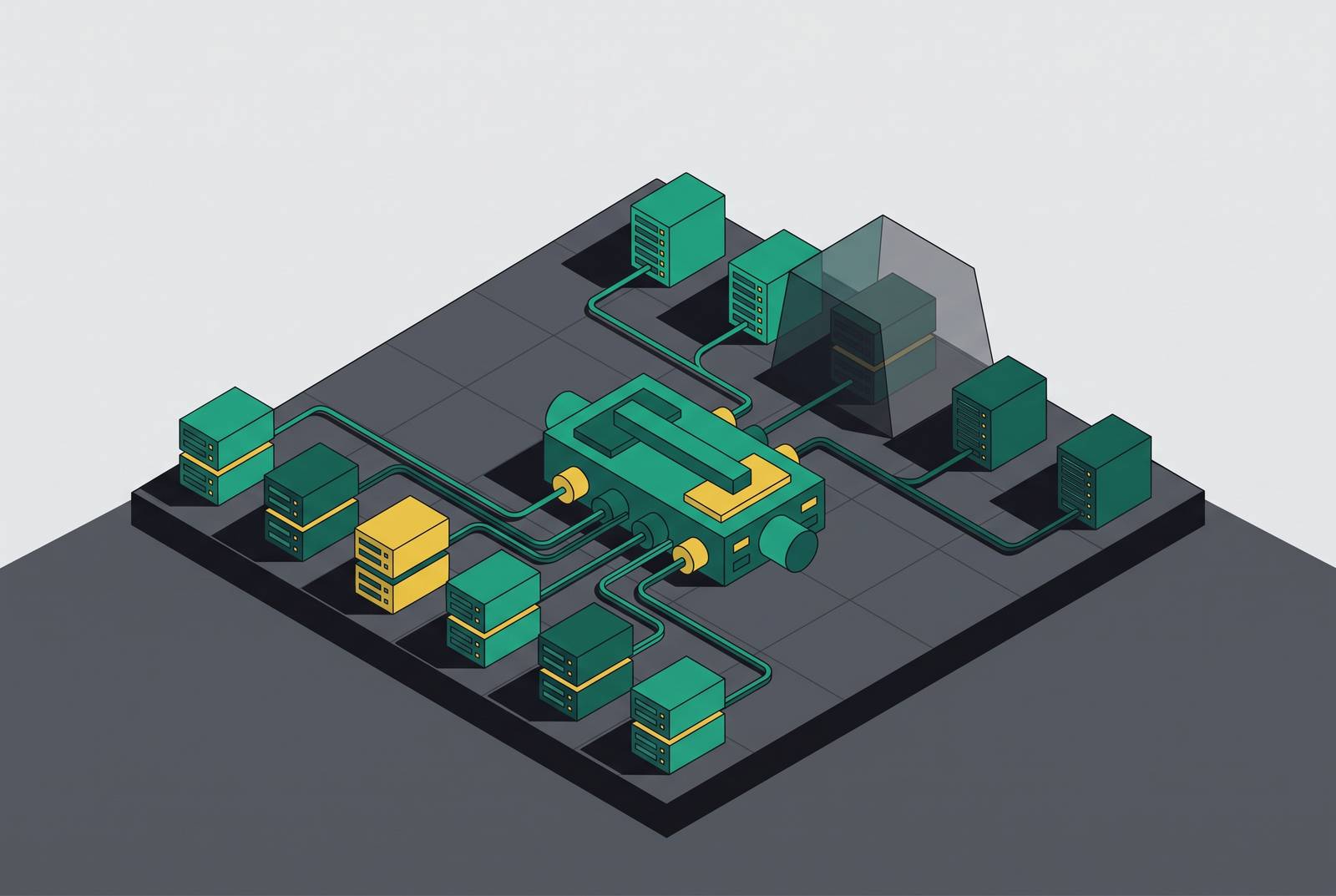
A gateway sits between an app and a model provider. By design, it can swap which model actually answers a request without telling anyone downstream, and that routing layer now carries most production LLM traffic heading into 2026. Nobody built these systems to be sneaky. They built them to be flexible, and flexibility without a paper trail causes a routing decision to show up on a dashboard as a cost spike or a quality drop with no clear cause attached to it.
Two failure modes matter here, and treating them as the same thing is the mistake most teams make. Substitution means a whole stream of traffic gets moved from one model to another. Dilution means only some percentage of requests quietly get served by something other than the model that was advertised, while the rest go where they're supposed to. Both happen by accident, through a misconfigured fallback rule or a cost-control script nobody documented. Both also happen on purpose, when a routing layer is protecting its margins. Either way, a team reading only the text that comes back has no way to audit what actually produced it, and this inability to audit is the real design flaw that the convenience produces.
A gateway exists so the app doesn't have to know or care which provider it's talking to, OpenAI or another lab or whoever wins the benchmark that quarter. That's the entire value proposition. But it also means a model swap is just a line change in a config file. The application code that sent the request never sees it happen, and depending on how the gateway was built, the team that owns that application might not see it either.
Three routing patterns carry very different exposure, and lumping them together is where a lot of teams go wrong. Simple fallback chains rank providers in order and walk down the list when one fails. The swap here is intentional, built for resilience, but it's rarely logged anywhere the caller can see. Weighted load balancing splits traffic across providers on purpose by percentage, so dilution isn't a bug in that pattern, it's the design working exactly as intended. Quality-aware or eval-driven routing picks a model dynamically at request time based on scoring logic, and this is the pattern where the caller may genuinely never learn which model handled any given call.
Auto-router modes take that exposure and put it on full display. Sending a request to a generic routing endpoint, like OpenRouter's "auto" setting, hands model selection entirely to the platform. That's a fine choice when the best model for a task genuinely varies prompt to prompt and nobody has strong opinions about which one runs. It's a bad default for production, full stop, because a team eventually needs to know what served a customer six weeks ago when something breaks.
Deprecation events force the issue into the open even when a team isn't ready for it. OpenAI ended ChatGPT's access to GPT-4o in February 2026, though only the chatgpt-4o-latest API snapshot got pulled; other GPT-4o snapshots stayed available. A change like that gets absorbed as a routing config update on the backend, so teams downstream of a gateway can go weeks without any notice that the model answering their workload has changed.
The cost exposure hiding inside a $100× price spread
OpenRouter pricing recorded in March 2026 ranged from $0.05 to $5.00 per million input tokens across listed endpoints. A spread that wide is a financial incentive dressed up as a capability difference, and it's the incentive that ought to worry a finance team more than the technical variance ever will. Whatever the marketing says about matching model to task, a gap that large is also a strong reason to swap what's running while billing for what was promised.
At scale, the math makes the incentive impossible to ignore. At scale, the gap between a cheap-tier model and a frontier model runs something like $72 versus $9,000 per million requests. A relay charging frontier prices while quietly routing to the $0.05 tier pockets that difference, and the team footing the bill has no way to catch it just by reading the outputs that come back.
The exposure cuts both directions, and neither is harmless. Silent downgrades save the provider money while the team keeps paying full price for answers worse than what they signed up for. Silent upgrades are the sneakier failure: fallback logic routes a request to a model more expensive than anyone authorized, and the bill shows it only after the fact. One documented production case involved a five-provider round-robin setup that sent unauthorized traffic to Claude 3 Opus, producing a cost spike nobody on the team had approved or even expected.
Between the two, silent upgrades deserve more suspicion than silent downgrades. A downgrade at least caps the damage at a lower price point. An upgrade someone didn't authorize can blow through a budget in a single billing cycle, and there's no dashboard alert built to catch a cost going up for a reason nobody flagged.
Output quality and compliance failures that silent swaps cause and teams can't easily catch
A customer-support copilot got migrated onto a five-provider routing pool running flat round-robin distribution. Hard-prompt quality scores dropped 12% after the migration. Nobody chose that outcome on purpose. It fell out of a routing policy that treated every provider in the pool as interchangeable, which they were not.
The deepest problem wasn't the routing choice. The missing feedback loop was. Without per-request model attribution, the team had no way to connect the quality drop to a specific model change. They knew scores had fallen. They had no idea why, because the logs never recorded which model answered which request, so the investigation started from zero every time.
Standard monitoring doesn't catch this kind of drift. A fallback provider can interpret an identical prompt differently than the primary model would have. A streaming response format can shift subtly between model versions without anyone flagging it. A cheaper or quantized substitute can produce answers that sound plausible and read fine, while being subtly wrong in ways that never throw an error code, never spike latency, and never trip an alert.
In compliance terms, this becomes a legal exposure rather than a quality problem, because unaudited routing decisions can trigger regulatory and legal consequences. Routing decisions made inside a gateway are nearly impossible to audit after the fact unless the gateway was built to preserve that trail. Without model lineage and PII traceability tied to each request, a team can't show an auditor, or itself, that its data governance actually held. These gaps rarely come from bad intent. They come from a record that was never kept, which is a much harder thing to explain to a regulator than a mistake would be.
What intentional, transparent routing requires in practice
Transparency has to start at the policy layer, and that means picking a side up front rather than leaving every workload on autopilot. Workloads where quality or compliance genuinely matters need explicit model selection, chosen and documented by the team that owns the outcome. Dynamic routing still earns its place elsewhere, but only where the team has defined the criteria ahead of time and can actually see what the routing logic decided in each case.
Per-request model attribution is the foundation everything else sits on, and skipping it is the single most common mistake in this space. Every request log needs to record which model actually served that request, not which model the caller asked for. Skipping this step means quality drift or a cost anomaly stays invisible until someone notices the bill or the complaints start piling up, usually weeks after the damage was done.
Fallback chains need to be declared, not implicit. A gateway should never retry silently across providers unless that fallback path was configured on purpose, with each hop visible somewhere a human can go check later.
Spend governance rests on capabilities that aren't optional extras, whatever a vendor's pricing page calls them. Cost attribution has to work by model, by team, by project, in real time, not reconstructed weeks later from a provider's monthly invoice. Optimization, routing, and caching all have a place, but only when they cut cost without hiding which model actually ran the request. A gateway that saves money by obscuring what it did with that money hasn't solved anything. It's just moved the problem downstream, onto whoever reads the bill next.
Features of a gateway that supports intentional routing
Counting features on a spec sheet misses the point. Every criterion that actually matters ties back to one of the failure modes above, so the questions worth asking are narrow and specific, grounded in those failure modes rather than borrowed from a vendor's homepage.
Does the audit log record which model actually served each request, not just which one got asked for? That's the baseline for debugging a quality drop after the fact or standing up to a compliance review. Skipping it turns every other feature on the gateway into decoration.
Is fallback behavior declared and visible, or does the system retry silently across providers the moment something fails? A gateway that fails over without logging the substitution has reintroduced the exact opacity a team was trying to get away from, just dressed up as resilience instead of called out for what it is.
Can cost be attributed in real time, by model, by team, by project, rather than reconstructed weeks later from an invoice? That kind of showback closes the gap between what a bill says and which feature, team, or customer actually generated that spend. Without it, cost is something a team learns about only after the damage is already sitting there, done, and there's no version of that arrangement worth accepting just because the gateway was cheaper to set up.