SSO and Identity Federation for Enterprise LLM Gateway Access
Federated identity ties every LLM request to a known user for automatic access control.
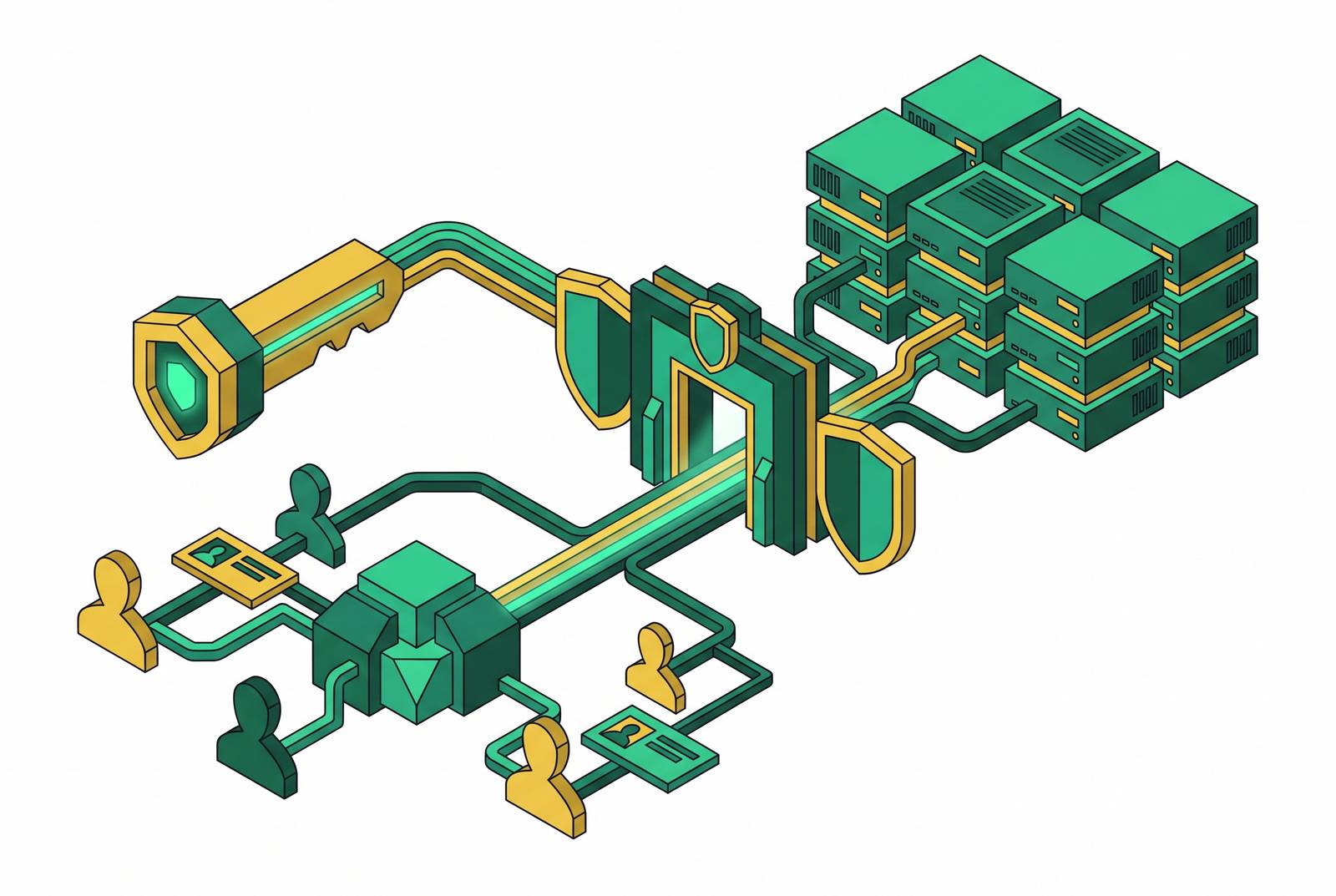
When every model request goes through an LLM gateway, shared API keys are no longer a workable access model. SSO and identity federation are what make that control plane actually enforceable. They tie every request back to a known user, team, or service account governed by the organization's existing identity infrastructure.
The gateway sits on the critical path of every model call. It routes traffic across OpenAI, Anthropic, AWS Bedrock, Google Vertex AI, and other providers. It holds credentials for the whole company and becomes the system of record for AI spend and access. At that scale, a handful of shared keys erases individual accountability entirely. When a key is used, the gateway cannot say which user, team, or service made the call. Cost attribution, audit trails, and policy enforcement all break at once.
You cannot track thousands of users as they join, move, and leave by hand. Access lingers after offboarding. Provisioning lags behind role changes. The failure is not theoretical. Enterprise LLM access control at this scale requires access to map to corporate identity and change automatically as people join, move, and leave. Manual key management cannot support that. Shared keys carry no identity signal, so there is no governance.
What federated identity actually means at the gateway layer, and why it differs from application-level auth
Federated identity at the gateway ties every request to a corporate directory record rather than to a credential the gateway itself issued. That is what makes provisioning and deprovisioning automatic and auditable. The gateway does not own the identity. The corporate identity provider does.
OpenID Connect (OIDC) handles the authentication handshake. The gateway delegates the question of who is making the request entirely to the corporate IdP, whether that is Okta, Microsoft Entra, Google Workspace, Auth0, JumpCloud, or any generic OIDC-compliant provider. The gateway never stores or validates a password. SAML 2.0 covers the same delegation for organizations whose IdP speaks SAML rather than OIDC. Together, SAML 2.0 and OIDC cover Okta, Azure AD, Google Workspace, OneLogin, JumpCloud, Auth0, and any compliant provider.
SCIM 2.0 handles the lifecycle side. Users are created on first login and de-provisioned automatically when the IdP record changes. Remove a user from Okta and their gateway session is revoked and their account de-provisioned within minutes. No manual cleanup is required. SSO-only enforcement closes the gap further. Disabling password and passkey logins for the domain ensures every authentication path runs through the IdP. There are no shadow accounts and no local credentials that survive offboarding.
Group-to-role mapping is the bridge between directory structure and gateway permissions. IdP groups map directly to gateway roles, whether Admin, Member, Viewer, or custom roles. Access changes the moment the directory changes, not the moment an admin remembers to update a key. This differs from application-level auth in one structural way. The gateway enforces these controls once, upstream of every application that calls a model. Each application does not need to implement its own auth logic.
How the gateway turns an authenticated identity into scoped, policy-governed model access
Authentication via SSO is only the entry point. The gateway then uses that verified identity to enforce a layered policy. The known principal carries a role, a data scope, a cost ceiling, and a model allow-list. A shared key cannot carry any of that.
The five structural building blocks are federated identity, fine-grained authorization, row-level data scoping, cost governance, and auditability. Together they embody key principles of NIST's Zero Trust Architecture, such as treating every request as untrusted until identity and policy are verified. But a full ZTA also checks asset health, device posture, and secure communications, not just identity and policy. But the identity and policy core is what the gateway provides.
RBAC decides which operations a role may perform. It decides which records that role can see, including keys, logs, and cost data. Least privilege in a multi-team platform needs both. A team member who can call models should not be able to read another team's prompts or spend data.
Virtual keys carry the policy. When a user or workload authenticates via SSO, the gateway assigns a scoped virtual key governed by an access profile that bundles provider allow-list, model allow-list, budget ceiling, and rate limit. Concentrate AI implements this through real-time spend tracking and limits by team, project, key, and model, so modifying the access profile updates permissions instantly across every downstream request without manual credential rotation. Hierarchical budgets apply across four levels: customer, team, virtual key, and provider configuration. They are checked cumulatively, so a business-unit ceiling holds even when individual keys sit under their own limits. An over-budget request is rejected before it ever reaches a provider.
The objection to all of this is predictable. Many teams say they already scope access at the application layer. The answer is that application-layer scoping fragments across every codebase, requires every team to implement it correctly, and produces no unified audit trail. The gateway enforces it once and produces a single record.
Why agent and service-account identities need separate treatment from human SSO
If autonomous agents inherit human credentials or use shared API keys, they collapse the audit attribution that federation is designed to create. Human users authenticate through SSO with per-user OAuth flows. Agents require a different mechanism: bearer keys, M2M tokens via OAuth client-credentials exchange, or workload identity federation. An agent should not inherit the human credential of whoever deployed it.
Workload identity federation is the most secure pattern for agents running on cloud infrastructure. The agent's own infrastructure mints short-lived OIDC tokens. The gateway validates them. No long-lived secret is held anywhere. Each autonomous agent needs its own identity, credential, scoped permissions, and audit trail separate from the human who created it. That is what makes agent actions attributable and revocable independently of the human operator.
The risk without separate agent identity is concrete. An agent running with a human's SSO session inherits that human's full permissions. It operates beyond its intended scope. Its actions appear in audit logs as belonging to the human. Both over-permission and incident investigation become harder. Model Context Protocol adds a tool-access dimension to this. Agents calling external tools through an MCP gateway need the same governed identity model: per-agent tool allow-lists, credential injection per call rather than stored long-lived secrets, and tool execution logged on the same audit trail as model calls.
What the audit trail looks like when identity is federated, and what compliance frameworks require
A federated identity layer gives you an audit trail that shared keys cannot. Every request is attributed to a known principal. Every configuration change is attributed to a known administrator. Both records are immutable and exportable.
Request-level audit logs capture the authenticated user or agent identity, team, virtual key ID, model version, token usage, latency, and policy enforcement outcomes per call. Guardrail verdicts and budget checks appear alongside the request metadata. Configuration-level audit logs capture who changed which control and when. Role assignments, key creations, budget edits, and policy changes are logged separately from request logs. An auditor needs both: what was sent to models, and who changed the rules governing that traffic. Concentrate AI includes role-based access control and audit logs that track every model call back to an authenticated user or service account rather than to a shared key, so individual accountability and spend attribution are possible at scale.
The regulatory backdrop makes this evidence necessary, not optional. The EU AI Act is in force, with general-purpose AI model obligations applying from 2 August 2025. High-risk system obligations are deferred by Regulation (EU) 2026/1744 to December 2027 and August 2028. The deferral extends runway but does not remove the requirement to document who may access which AI systems.
Zero-data-retention and metadata-only auditing are not contradictory. Compliant ZDR architectures log timestamps, session identifiers, token counts, latency, and policy enforcement outcomes without storing prompt or response content. This satisfies SOC 2, HIPAA, and GDPR audit requirements while maintaining data ephemerality. SIEM export via OTLP, Splunk HEC, S3, GCS, or BigQuery closes the loop between the gateway's audit trail and the organization's existing security operations infrastructure.
How real gateway implementations wire SSO and federation into production: four approaches compared
Implementations differ not in whether they support SSO but in how deeply identity federation is woven into cost governance, audit logging, and deployment topology. That depth determines whether the gateway is genuinely enforceable or only partially governed. Azure AI Foundry and Azure API Management lean on Microsoft Entra ID for identity and access control, but they also support API keys, subscription keys, and other identity providers. Applications authenticate via managed identities or OAuth 2.0 bearer tokens, eliminating raw keys. Administrators use standard Azure RBAC to delegate control over gateway definitions and backend pool configurations. It is deeply integrated for organizations already on the Microsoft stack and less portable outside it.
The meaningful differentiators across these implementations are consistent. Does identity federation extend to cost governance and audit, not just login? Are agent and service-account identities governed by the same policy engine as human users? Can the gateway run in a private VPC for regulated workloads? Are compliance controls such as SOC 2 and a HIPAA BAA available without an enterprise procurement process? A gateway that answers yes to the first question and no to the others is still only partially governed. The identity layer is real, but the policy engine stops at the human boundary.
What breaks when identity federation is missing: the audit, offboarding, and spend-attribution failures
If federated identity is missing at the gateway, you get three specific, recoverable but costly failure modes. Orphaned access, unattributed spend, and audit gaps surface only when an incident or regulator forces a review. Each one traces back to the same missing signal: the gateway cannot say who made the request.
Orphaned access is the most common failure. When an employee leaves and their IdP account is deactivated, any API key they held continues to function until someone notices and revokes it manually. Without SCIM-driven deprovisioning, that gap can persist indefinitely. The key carries no identity signal that would flag its use as anomalous. Spend without identity compounds the problem. Per-member spend caps enforced at request time require the gateway to know who is making the request. Without SSO, budget enforcement collapses to per-key limits that do not track to individuals or teams.
Audit gaps are the failure that regulators actually ask about. Without per-request identity attribution, the audit trail can say a model was called and what was sent, but not who made the call. That fails the question of who accessed what. SOC 2 Type II, HIPAA, and the EU AI Act's access-documentation requirements all pose that question. The cost of reconstructing the answer after the fact is slow and error-prone. Shared keys aggregate all usage under one credential, so you need to rebuild usage from application logs to attribute cost per team and per project. By the time the reconstruction is complete, the budget was exceeded days earlier.
How to evaluate whether a gateway's identity integration is production-ready before committing to it
Most gateways claim SSO support. The depth of that integration determines whether the gateway is actually enforceable in production. The evaluation comes down to a handful of specific questions.
First, authentication depth. Does SSO cover the control plane only, the dashboard login, or does every API request carry an identity token traceable to the corporate directory? A gateway that requires SSO to log in but accepts shared keys for API calls has not solved the attribution problem. Second, SCIM coverage. Does the IdP integration handle provisioning and deprovisioning automatically, or does offboarding require a manual step? Ask specifically whether removing a user from the IdP revokes active sessions and any API keys issued to that user.
Third, role and policy depth. Can IdP groups map to gateway roles and access profiles that include model allow-lists and budget ceilings, or only to coarse Admin and Member distinctions? The governance value is in the policy bundle, not just the login gate. Fourth, agent identity. Does the gateway support non-human principals, including M2M tokens, workload identity federation, or per-agent credentials, with the same RBAC and audit coverage as human users? Or are service accounts treated as shared keys with a different name?
Fifth, audit completeness. Do the audit logs attribute every request to a specific principal, not just a key? Are administrative-change logs kept separately and immutably from request logs? Ask whether logs are exportable to the organization's SIEM and whether they satisfy SOC 2 or HIPAA audit requirements by design. Sixth, compliance controls. For regulated workloads, is a BAA available? Is ZDR achievable without negotiating a custom enterprise agreement? Are PII and PHI redaction policies enforced at the gateway before requests reach model providers?
Deployment topology matters for workloads that cannot egress to a vendor network. An in-VPC or air-gapped deployment must support the same identity integration. The managed versus self-hosted decision is the final structural question. A self-hosted gateway means you run the identity infrastructure yourself: certificate rotation, IdP connector maintenance, and clustering. A fully managed gateway such as Concentrate AI removes that burden but still enforces the same identity controls. That matters for small teams that need enterprise-grade compliance on day one without a dedicated platform team. Identity federation is not a configuration detail. It is the foundation that makes every other gateway control enforceable.